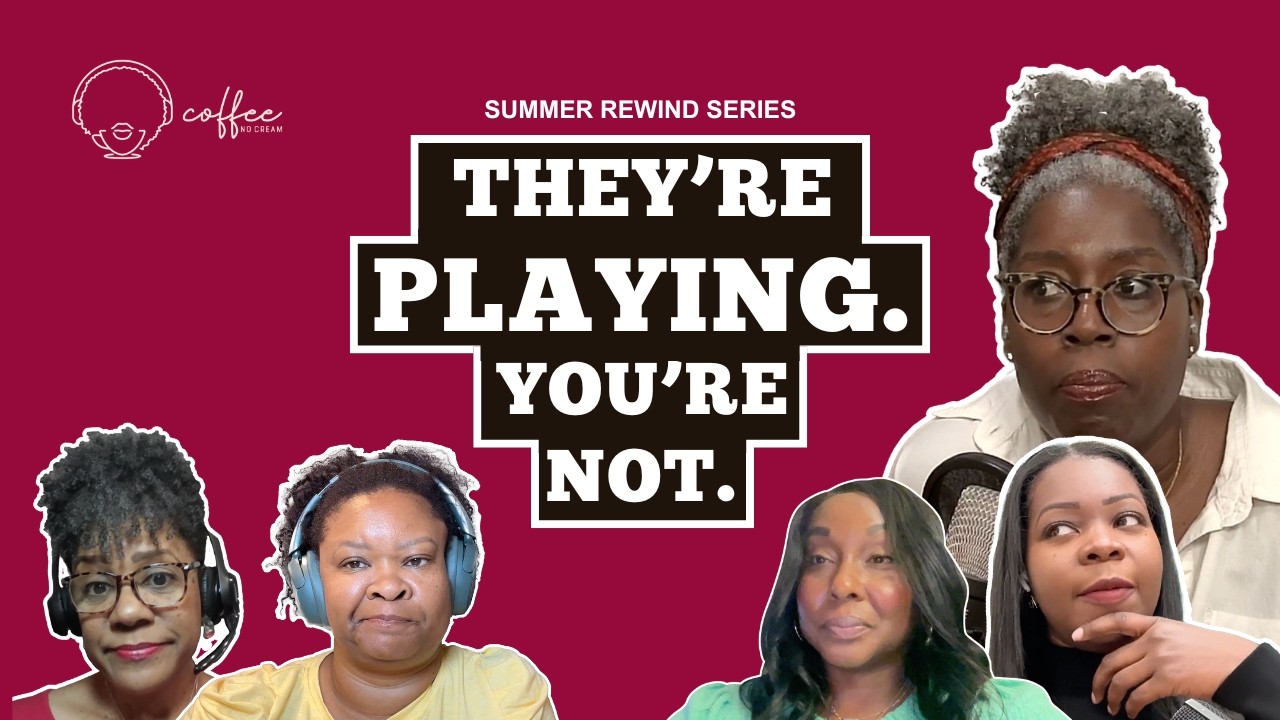
You may think you're not playing the game at work.
The truth is, the game is being played whether you choose to participate or not.
After more than 60 conversations with Black women, one lesson continues to surface: success isn't just about working hard. It's about understanding the unwritten rules, protecting your peace, setting boundaries, and moving strategically.
In this Summer Rewind, I'm bringing together insights from Bernie Frazier, Ashley Morgan, Tracie Walker, and Abby the Attorney as we discuss what it really means to "play the game" without losing yourself.
Whether it's navigating office politics, deciding when to speak up, attending the happy hour you don't want to attend, or learning how to remain unbothered, this conversation is about making intentional decisions that move your career forward.
Because whether you call it "playing the game" or not...
They're playing. You're not.
Listen to the Audio
Bernie Frazier (00:00)
If you're going to be in corporate, if you're going to play that game, then master it so that you get out of it what you want.
Erin Braxton (00:08)
Everything is competition. Life is full of game.
Ashley Morgan (00:11)
People say it's exhausting to have to play that game. And I'm like, well don't do it then. And then continuously complain about where you're at in your career.
Erin Braxton (00:20)
Depending on what your job is, there is a level of extracurricular activity that you are required to do, whether it's written in your work description or not.
Tracie Walker (00:31)
You always know just the threat level by how you're treated. You're definitely being studied. I
Abby the Attorney (00:36)
I tried to get out of it and I just couldn't I couldn't make it happen.
Erin Braxton (00:50)
Hey everyone, welcome to the Coffee No Cream Podcast. My name is Erin Braxton, and I'm the host of Coffee No Cream. Here on Coffee No Cream, we are unapologetically dedicated to Black women, and we share what I like to call coffee no cream moments, those things that happen to us black women in business and in life just because we are black women. Now, today is the third in our summer rewine series, and we are gonna be talking about the game.
And playing the game as black women in business, as black women in corporate, in life. Now, I have brought this topic up several times. If you watch me, if you've been watching me for a while, I have talked about this in numerous videos. But we've also had this conversation with many of our guests. We've talked with Bernie Frazier about it. She's a corporate coach. She even has a whole framework to work through the game of moving up in corporate.
We've spoken to Ashley Morgan, we've had conversations with Tracy or Thinking Out Loud, we've had the conversation with Abby the attorney. So this is something that comes up often. I think so many times, many of us who consider ourselves not to be competitive, who don't want to play games, we don't like it when we're talking about playing the game. But if you want to be in corporate spaces, if you have to be in corporate spaces,
Corporate spaces. If that is the way that you get your money, there is a level of game that needs to be played. Maybe you call it something else. Maybe you don't like the word game. I don't know. But there is game associated with being a black woman, working, navigating those spaces. So we're gonna reflect back. We're gonna look at some of the conversations that I've had with Bernie, some of the conversations that I've had with
Ashley Morgan and Tracy thinking out loud and Abby the attorney because I'm not just making this stuff up, guys. I don't, I don't need to play games just for the sake of playing games. I'm saying this as a way to help you guys propel yourselves forward to think strategically so that you can get what you want out of your job, out of your careers, out of your life. All right. So before we get into it,
I just want to ask you guys to please like, please share, please subscribe to the podcast channel. hit that subscribe button so you can be notified every time we have a new video come up. We also have a Facebook group, coffinocream.com forward slash free, is where you can download or access almost 2,000 free educational resources. And I think that's it. So I will see you over there.
Bernie Frazier (03:39)
If you're going to be in corporate, if you're going to play that game, then master it. So that you get out of it what you want. And I have coached I'm in year twenty nine for coaching. I have coached so many people, you know, a lot of black people, a lot of black women especially. That's probably the largest demographic that I've focused on. But I have coached white men, Hispanic women, Indian men. I've I've coached all.
And one of the biggest challenges that I have seen consistently is one, people don't really know what they want, or if they do know what they want, they're afraid to go after it. And because of that, they end up settling, which means you end up frustrated, which means you end up not getting what you want. And so one of the things that I have shared with audiences when I do speaking.
And I've shared it with clients, is this whole notion of the unwritten rules. Because there are some in corporate and there's some at every level, there's some in every job and every company. And a lot of times we as black people, and I'll say we as black women, we don't take the time to get to know those. So we end up beating our heads doing all of this stuff that we think should work and it's not working for us.
And I always say it's because you don't understand those things that are not written down, but they're just really critical for you to know in order for you to start to get what you want out of the deal.
Erin Braxton (05:11)
Okay, so when you say a lot of us don't know what we want, go into that. What do you mean by that? We don't know where we wanna go, we don't know where we're headed, we don't know how much we wanna make, what is it?
Bernie Frazier (05:22)
Yeah, so I'm glad you asked. I probably I would say for maybe the last fifteen years, I have anybody who watches this, if they know me, they'll probably start laughing. 'Cause I ask this question everywhere I go. And that question is, what do you want? So probably over the last fifteen years, I have really started to fuse this question into my coachings, again speaking, just in general conversations. And if I had to guess
At how many people couldn't give me a clear answer, I'd say about ninety-five percent. They can't clearly articulate this is what I want w out of my work. And I'm talking about work, you know, your vocation or whatever. And I always think if you don't know what you want, then how would you recognize it when you see it? Or how do you know where to put your efforts so that you get it? So what I have found most people out here, they're reactive.
They're very tactical about their career. They're not strategic at all. And I'm going, This is why you're not getting what you want, because you're just well, you know, they offer me the job and they're gonna pay me a little more money, so I took it. And I tell people, most of my corporate career I did recruiting. I was a recruiting leader. And I know how to pimp you. I come to you with a little bit larger title. That's the reality. That's how I'm pimping you. I give you a little bit larger title. Uh-huh.
I offer you more money. And the overwhelming majority of people will fight to take it. And they never stop and ask, is this in alignment with what I want? So they keep taking assignment after assignment like that. And then they look up 15, 20, 25, 30 years down the road and they're miserable or what I call their bored, burned out, or frustrated. And I'm going, well, let's talk about why. You've been going down a path that wasn't even what you wanted.
Erin Braxton (07:17)
Mmm. Mmm. Okay.
Bernie Frazier (07:20)
Yeah.
Erin Braxton (07:22)
People say they don't want to play games because they feel like if they're playing games, it is not productive. It is not serving them well. They feel like it's petty. It's silly. It's not it's not mature, right? But that's not true. I think the bigger mistake.
misconception, misunderstanding when you say you don't want to play games out here is that by not playing them, you're you're you're still not in the competition, right? Everything is competition. Life is full of game. All right. And I'm not saying that because I particularly like playing games, because I confront people, I like to meet them at face value. I take them at face value.
I feel or I used to feel like, well, I'm being honest. So they must be being honest. And and and this is the way I would handle it. So that's the way they're handling it. And and when I really matured and learned that that is not the way the world works, and it's certainly not the way it works for a black woman in business, it's just like my eyes have opened. I have been let down, hurt, upset, diminished.
All of the things because I just was walking around out here in La La Land, not playing to win. And people will say, Well, I don't wanna I don't wanna win. I just wanna that's fine. If you don't wanna participate, sure, you're not participating, let you tell it. But you are participating. People will say, you know, I don't like to be competitive, I I don't like to compete.
I call bullshit on that as well because I feel like everything we do is a competition. Everything we do. When we go out for a job, it's a competition. When we're dating, it's a competition. When we're vying for attention from anybody, just anything we're doing, it's a competition. We are in a game and black women the game is twice as strategic, three times, four times, five times as strategic and challenging for us.
Ashley Morgan (09:40)
People say it's exhausting to have to play that game. And I'm like, well, don't do it then. And then continuously complain about where you're at in your career. Like, you know, it feels exhausting when you don't know how to do it, but if somebody gives you a roadmap and just helps you come into understanding, you know, I talk a lot about executive psychology and and buyer psychology and just understanding how they think. Because when you understand how someone thinks, you can
modify your behavior as needed.
To just get from them what you want. So people will be like, that's manipulative. I mean, I think to a certain degree we're all manipulating everyone, right? We all exist in this marketplace. You know. So it you have to be doing it with intention though. Like this is what I want for my career next. This is what's purposeful and meaningful for me. And so I'm going to advocate for myself in this way to this person. So, you know, I think understanding again that corporate to marketplace and you know what your product is and then
Knowing how to talk about it, the the thing I would say probably most is you've got to know how to translate the results you create into language that lands with like your frontline team, right? I work mostly with leaders. So you've got to be able to speak in a way that lands with your frontline team, a way that lands with your peers, and a way that lands with senior executives. And they all need a different type of communication. When you know what those things are, when you know what that looks like, you you just
Your path gets easier, your path gets smoother. The challenges that we face, like they just are a part of our reality. And so we can spend a lot of time arguing with what has been, or we can just acknowledge those are circumstances and I choose to rise above. And I'm equipped to rise above. I'm capable of rising beha above.
Erin Braxton (11:35)
When you work in a place, depending on what your job is, there is a level of extracurricular activity that you are required to do, whether it's written in your work description or not. That's just fact. Okay. Now, a lot of times people try to insinuate themselves into what it is you have going on or decide for you.
What you can and cannot do. When people ask you to do things that you don't want to do, for example, they want you to go to happy hour, they want you to go drink, they want you to do that, do this, whatever. You don't have to say no all the time and just distance yourself because let's be honest, you're trying to preserve your job. You might be trying to advance yourself in this organization, you might need these people as a reference one day.
Okay. So you can't just completely disassociate yourself cum completely. That that you know, you have to play along to get along. And that's just the way it is. We don't want to be at work in the first place, but we do have to be at work. So realistically, depending on what job you have, you are going to have to do some shit you don't want to do. You are going to have to socialize and do some shit you don't want to do. And you know, it's not always terrible, you know. Work events can be fun.
They can be cool, you know. You don't have to participate in everything, you know, put a boundary up, decide, okay, I'm gonna go to one happy hour every, you know, quarter. If that's enough for you. Because I guarantee you, in a lot of situations, if you don't, unfortunately.
They are going to be looking at you in a certain way. People can disagree with me if they want to. And and you don't have to. But I'm suggesting that you play along to get along while you have your boundaries up and you're planning your exit, your strategy to get out, to get another job, whatever it is you're doing. You're not trying to burn bridges with these people. You're just trying to be cool so you can utilize their reference or whatever. All right. People ask you to do stuff, don't give them a hard no. You know what I mean?
You don't have to act funky like I no, I don't do that. You could just be like, you know what? my God, that sounds so cool. I would love to. But blah, blah, blah. I've got this other thing planned. my gosh, yeah, I know. I've got this other be lovely about it. And then, you know, every once in a while, go. Whatever. When they start talking about what old girl's doing in accounting or what old girls doing or old boys this or so and so is sleeping with so and so.
Don't be a part of it, pivot the conversation. Act surprise really? And pivot the conversation. If they keep talking about it, move on around to the next person at the happy hour. There are ways around it. Ways around dealing with the bullshit. I'm just telling you that if you need to play along to get along, that's fine. Sometimes, a lot of times, white people or people at work are
are a problem, but they're not the problem. And that's the that's the distinction that you need to
Tracie Walker (15:03)
Make
you always know just the threat level by how you're treated. You're definitely being studied.
Erin Braxton (15:09)
How
do you handle this stuff now that you're seasoned in it, where you know, you've been working, you've got the experience. When this stuff happens today, like how do you how do you deal with it?
Tracie Walker (15:20)
For me I've reached a level of unbotheredness in the sense that you know, like a lot of times I've had I I know I did a video a few weeks ago about this attorney I was leaving the office to go get some coffee and she was with a group of law clo clerks, they were coming back from court and she just stopped me and was like, Where do you think you're going? And you know, most people would try to explain themselves or say something or like clap back like I'm none of your business or whatever. And I just kinda looked at her like this and I went and I turned around and I crossed the street.
I didn't even say anything to her acknowledge because I've learned, you know, sometimes you do have to say something and there's a way that you can say it that will make them kind of step back, you know. Right. But a lot of times if I'm quiet or I just kinda look at them a certain way and walk off. I mean, there's seriously been instances where somebody's made a comment about, well you're all dressed up today, you know, what's the occasion? I won't say anything, I'll just keep walking. Or I might say something like, I just like to look nice. I take pride in my appearance. You know, you can
Say it like that instead of just going completely off the rails because you know, we can't do that. I mean we can, but it just it causes more problems. But that is pretty much how I've handled things. Also, I will go and say something to the manager. Even if I know that they're not going to address it, they might just brush it off 'cause I've, you know, I've had things come up in previous jobs where I'll go to that person first and I'm like, What you said was offensive, or do you realize how this came across? And you know, then you get this vein
you know, ignorance like, I didn't mean it that way and but it sticks because they act differently around you. They might change their tactics because you've called them out. They don't like that. But it's definitely made them rethink how they approach you. So
Erin Braxton (17:02)
How is it how does it play out? Like have you noticed a difference? Cause I'm interested, like, when you just look at them and don't say anything and keep going, because that's so not my personality to do that. But I love that. And I just don't encounter this kind of stuff so much anymore because you know, I'm just not in an office. But do you find that that angers them? Do you find that that works and just kind of shuts it down?
When you choose that approach.
Tracie Walker (17:33)
yeah, it does. It angers them very much. And it d it depends on who it is. Because if it's somebody that's very much like this one attorney that I had worked with and I've done a couple of videos about her in particular, she was very much you have to figure out what that person is. She was a control freak. And she didn't like that I wasn't one of those paralegals that was just, my gosh, you're an attorney. How can I be of service to you? And you know, of course we're there to help them, but we're not there to kiss their feet.
Right. And that's what she was expecting. And so and even the office admin, you know, we'd had a situation where I had to go to her and she said, This is the problem, you're not catering to her the way that she thought that you would or that other people did. And so with her it is acting having that attitude of indifference and just being unbothered because she wants you to get upset. She wants you to argue with her and get a rise out of her. And so when I respond that way, I'm just kind of indifferent, like, I don't know, or she might
say something snarky like, well, you know, this is how I wanted this done. Or I'm like, okay, could you s send that in an email, put that in writing, please? And I'm still calm. She's kind of standing there like a child who just threw a tantrum and just looking, you know, crazy. You know, it's just there was one particular thing that she had done. She had copied the shareholder on an email she sent me about something when it could have been a very simple, hey, when you're doing these type of pleadings, would you please use this template? That's all she had to do.
But she sends this email, and this was like my first week at this job, as a paralegal, and it was just this two paragraph email. Please do this and please make sure that you do this. And also you need to do this, and you know, you didn't do this the last time. Like just Erin
Erin Braxton (19:12)
This woman.
Tracie Walker (19:14)
She was an associate attorney that I was working with when I worked at a private law firm. Uh-huh. And it was just this whole thing and she had the shareholder copied, and I thought she's really
Trying to put out here, see, look, she's she's not doing things that I like. Like it was very much just kind of this whiny, bratty-like, you know. And after she sent the email, she steps out of her office because the way the office was set up, my desk was right outside her office. Like she literally could walk out and take a few steps and she's right there. Right. And she said, did you get that email like that? And I said, I did. I said, Thank you. And she said,
I I just thought it'd be easier to send you an email and I just wanted to make sure and she was referring to the shareholders. Said I just want to make sure he was aware, you know, that I was just letting you know how we do things around here. But really she wasn't. She was complaining and being passive aggressive. Sure. And I said I said, I said, That's great. And I said, I appreciate you also attaching a template for me to look at to use going forward. And she just looked at I mean, the look on her face was just like
And after I said that I turned back to my computer, kept typing, you know, going back to what I was doing. And she stood there for a few minutes and I could just feel her staring at me and then she just turned back around and went in her office. And then later on that day, she went out to get lunch and asked me if I wanted anything and I said, No, thank you. And she comes back anyway and brought me some like iced coffee. I said, No, thank you. I'm good. And she still just kinda
So it's you know, it's things like that. And you know, then there are some people you can act that way too, or you can say something kind of witty or snarky yourself, but it doesn't really sound that rude, you know. Right, right. And they will immediately just back off. But you get, you know, I'm not gonna say anything to her 'cause she got all but but they won't do it. So I feel like that's been effective. You know, there are times when you do just have to kinda go postal on people.
Erin Braxton (21:06)
I like that though. What did you call it? Something of unbotheredness. What how did you state that?
Tracie Walker (21:12)
It's a level of unbotheredness.
Erin Braxton (21:13)
I like that. Yeah. I like that.
Tracie Walker (21:16)
And not that you're excusing the behavior, but it's just like, I'm not gonna let there was an episode on the show, Insecure. I don't know if you've seen the watch the series, but there one where Molly's working at this the law firm and she finds out that one of the associates who's a white guy is making more money than her and her she's out having drinks with her friend and he says, Stop letting these white people stress you out. Mm-hmm. And that was something that my parents would always tell me, you know, we'd come I'd come home and I'd say, this happened, or I'm calling them and telling them.
'Cause it's just it's all about just trying to get us rallied up and act out of character.
Erin Braxton (21:49)
Let's just say somebody sends me a text message on a Saturday. If I respond to it right then and there, they're gonna know that if they send me a message, I'm gonna respond. If they call me and I pick up the phone and like, what's up? They're gonna know that I'm gonna pick up the phone. And sometimes they'll call once and sometimes they'll keep calling and keep calling to see if you'll pick up. People will test you, right? And if you give them an inch, they're gonna take a mile. That's just what people will do. So
Say somebody texts me and you wanna respond. It's bothering you. You you really just wanna just give them the answer. I I just I just wanna respond. What I do, I respond, but I schedule the send and then I've done it. It's off. It's off my chest and it's done. Because what I don't want them to do, even if they sent me an email and I'm just scrolling through my email one night and I see they sent me an email at like
10 o'clock at night and I want to respond. I don't want them to know that I'm up working at 10 o'clock at night, even though I have been in the past and I will be. I will schedule the email to go out the next morning sometime. I won't send a response at that time because even if they're in bed by the time you respond, this sort of behavior is telling them that you work outside of normal business hours, right?
So black women, our our desire to give and nurture and rescue and save the day, we gotta cut that shit. Work trip. Everybody's going.
What do you do? I mean, they're like, let's get drinks, let's go dinner. Obviously you're there for work. It's it's often not mandatory, I guess, but it's expected.
Abby the Attorney (23:37)
It's an annual trip to Lake Lanier. Yes. Lake Lanier. First year of that event, I tried to get out of it and I just couldn't I couldn't make it happen. And so what I decided to do instead was I'm just not big off the boat because what they would do is go out on a boat, the boat would park somewhere, and everyone swims and paddles around. I did not want to be in my swimsuit around these people, not even a one piece. And so
My idea was I'm just gonna stay on the boat. I'm not taking any of my clothes off and I'll just find ways to still talk to people 'cause the point is I you know, I'm supposed to talk and make friends and and develop relationships outside of my, you know, a few people that I work for and get more work and get more clients and blah blah blah blah blah.
Erin Braxton (24:23)
So, as you can see, we've had a lot of a lot of conversations around playing the game. And I just want to encourage you to look at it differently, to look at playing the game as a way to get what it is you want. Because whether or not you call yourself playing the game, the game is still being played around you. You are in the game. You are in there, whether you choose to participate or not.
And most of the times, if you don't participate, you're not gonna get what you want. You need to put your boundaries up, you need to be strategic in how you're moving and flowing through these workspaces and workplaces, how you interact with people, how you choose to engage in the office. All of that I'm calling all of that game. So leave me a comment. Tell me how you guys play the game, how you deal with conflict at work as part of playing the game, how you show up.
when it's time to travel with people, when it's time to go to happy hours, when it's time to react or not react to coworkers who are trying to play game with you. I want to hear about it in the comments. So hopefully there'll be some good conversation down there. Cause you know I love to engage with you guys in the comment section. So that's it. That's all. Thank you guys for watching and I will see you in the next one.