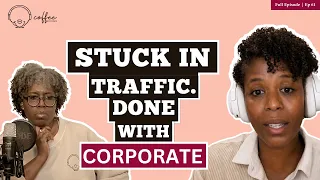
She was eight months pregnant, stuck in a four-hour commute home, and done.
Jamila Souffrant joins me on Coffee No Cream to talk about what happened next. She's the creator of the Journey to Launch podcast and author of Your Journey to Financial Freedom, and her story is proof that financial freedom isn't about luck; it's about a plan. In two years, she and her husband saved $169,000, and she walked away from corporate for good.
We get into the five levels of financial independence, why an emergency fund isn't enough, and the FU fund that gave her the runway to leave.
If you've ever sat in traffic wondering if this is really your life, this one's for you.
Listen to the Audio
Jamila Souffrant (00:00)
Working in corporate America. I had a very long commute from Brooklyn to New Jersey and then grew to almost two hours one-way driving. I did not want to work in a corporate office forever. I didn't want to be stuck to like the corporate handcuffs. I was pregnant about seven, eight months. Big my commute that time took four hours to get home. And it was from that.
the desperation of I can I don't want this to be my life. Even if you only bring home a dollar and you save a penny, you have to save what you're earning. So in the two years that I started Journeys Launch and then quit, we had invested and saved $169,000 across our retirement accounts, investment accounts, and savings accounts.
Erin Braxton (00:41)
Where was the money coming from in that that was allowing you to feel comfortable enough to leave your job?
Jamila Souffrant (00:48)
If you have your back against the wall right now, meaning you got financial troubles or you don't like your job or your situation, I think that is a powerful tool to push you forward. There are five levels that you travel through to reach financial independence.
Erin Braxton (01:02)
Okay, let's talk about the FU fund.
Hey everyone, welcome to the Coffee No Cream podcast. My name is Aaron Braxton, and I am the host of Coffee No Cream. Here on Coffee No Cream, we are unapologetically dedicated to black women, and we share what I like to call Coffee No Cream moments, those things that happen to us black women in business and in life, just because we are black women. Today I have Jamila Suffront. She is the creator of the Journey to Launch podcast. She is also written the book Journey to Launch and the book Journey to Financial Freedom.
I have been wanting to have a financial expert on here for us for a while. And Jamila just talks about how she was able to leave corporate America and find financial freedom through her podcasting, through her passion, through h documenting her journey to being financially free. We talk about ⁓ creating
not only an emergency fund, but an FU fund, which I love. And yeah, it's just a fun conversation. So if you are looking for financial freedom, as I'm sure most of you are, I know I am still, you'll definitely want to stick around for this episode. For those who haven't already, please like, please subscribe to the podcast. Please share this to those who you feel might find value in it. the Facebook group link is below. We've got over
Well, almost two thousand free resources, coffee no cream dot com forward slash free. ⁓ and that's it. So I will see you in the episode. Okay, Jamila, welcome. Thank you so much for being here. How are you today?
Jamila Souffrant (02:50)
Thank you for having me, Erin. I'm excited to chat with you. I'm good.
Erin Braxton (02:53)
I'm
excited too. I hear you. I hear that accent coming through. I hear it. I hear Brooklyn. ⁓ so I've really been wanting to have ⁓ a financial expert on for a while now. So when I reached out to you and you were so gracious and wanting to come on, I was just like, I'm so excited. So let's just start from the beginning. Okay. So you were born in Jamaica, am I correct?
Jamila Souffrant (03:20)
Yes.
Erin Braxton (03:22)
Yes.
I have a lot of Jamaicans that have been on Coffee No Cream. It's and it's it's it's incredible. Anyway, so you're raised in Brooklyn. Tell me, did financial freedom was that even a thing discussed in your household growing up? Was that a thing?
Jamila Souffrant (03:42)
No, I mean so I believe like many immigrants and people raised with limited resources or by a single mom. So I was raised by a single mom, that you discover the importance of money with the lack of it or just the resourcefulness of your family. And so I came here when I was about t a little under two years old and my mom was pretty young when she had me. And so while she didn't really impart
Well, I would say this. I learned about saving and making a dollar stretch from my mom and grandmother because I did have a bank account. Remember my mom taking me to open my first savings account at about five or six years old. And my grandmother who came here to this country also she had to work she she worked as a nanny and my mom worked minimum wage jobs before she started to get her degree and it was always you save something
You say even if you only bring home a dollar and you save a penny, you have to save what you're earning. And so that's something that was instilled in me. But otherwise, the idea of money or investing and becoming financially free wasn't something I discovered until later in my working years and started to implement what I what I do now.
Erin Braxton (04:54)
Okay, so tell us about the beginning of your blog and w how that kind of came about and you know, it it turned into obviously so much more, but tell us about it.
Jamila Souffrant (05:05)
Yeah, so I started Journey to Launch at and it was actually called Mrs. ⁓ Frugal Fab at first. So it was like a blog, a WordPress blog. And quickly I decided I didn't want to like be known for being frugal and I w wanted to change the name. So I just start came up with Journey to Launch. And it started more out of my discovery of the FIRE movement. So the financial independence retire early movements known as FIRE.
And I was working at a job that paid well. I was in my kind of late twenties, early thirties and I was working in corporate America. I had a very long commute from Brooklyn to New Jersey. It was about an hour and a half and then it grew to almost two hours one way driving. Wow. And I realized and this is something I knew when I was young and even started when I started to work was that I did not want to work in a corporate office forever. I didn't want to be stuck to
like the corporate handcuffs and to a paycheck. I knew I wanted wanted freedom. I always felt that. I just didn't know that that was possible. I thought you had to work and you had to work until your retirement age and that was the way things were. And as I started to kind of climb the ranks a little bit in my job and make some more money, my commute got worse and I I was just like, wait a second, is this gonna be my life? And what really kicked it into gear was getting pregnant. So I w I got married, got pregnant and it was with my first son
I was pregnant about seven, eight months, big, my commute that time took four hours to get home. It was like a crazy c like day. It was like all the traffic gods were unpleased and just like anything that could happen happened. And it was from that the desperation of I can I don't want this to be my life. Because I knew I wanted more kids. I knew I just needed freedom. And so I started to Google how to quit my job, how just
catchphrases that you hear that you don't know what it means. Right. Fine financial freedom. I was just putting words together and I discovered blogs and podcasts from people who were saving and investing to be able to quit their jobs and retire early. And I was like, wait a second, what is this? And so I s just consumed all the content I could and over time it inspired me to start the blog journey to launch and then the podcast a year later to say
I'm gonna reach financial independence. I wanna one day quit my job and not have to work in a traditional environment anymore and I'm gonna document how I do that. And that was the impetus and the motivation for me to one, look up how to reach freedom and then to share my own journey, which then became my platform in which I help other people do the same thing.
Erin Braxton (07:42)
So how long did it take from the time you started the blog to the time you left your job?
Jamila Souffrant (07:50)
That's I love I love this question because it shows the power of action and starting the journey to financial independence. So when I started Journey to Launch, I I had a goal that I would reach financial independence, meaning quit my job and do what I wanted. ⁓ so if I chose to work, I could in seven years. So at the time I was 33 when I officially launched the the podcast or the blog. And then I said by 40 years old, I'm going to be able to invest and save.
As a unit. So I have a husband and at that time I'm trying to think how many kids I had at that point. I have three kids total now. But so I started with the idea of seven years of taking my income from this job. My husband had a you know, has this job. We're gonna in aggressively save and invest for seven years for me to be able to quit my job. And by the time I got pregnant with my third child, my daughter, in two thousand seventeen, I realized that I did not want to wait
Till I was 40 years old. At that point, I was, I believe, around 34, 35. So I had about five more years left. So that that was a quick actually jump from me starting saying it's gonna take me seven years, now I'm two years in saying I don't want to wait those five years. I'm 35 now, about to have my child. So how can I make this freedom happen sooner? And so I switched strategies where instead of investing and saving aggressively into our investment accounts.
I saved into a FU fund, which we can talk about. And started to plot. Yes, started to plot what it would look like if I left my job earlier than my design date before I even had all the money in the world, but I had enough to take this leap into entrepreneurship and to also just having more flexibility in my life. So I was able to quit my job in two thousand and eighteen and pursue journey to launch as a platform and business full time.
But I made sure I had enough leeway though that if it didn't work, like we'd be okay financially.
Erin Braxton (09:48)
Okay, so before we talk to this FU fund, because I love it. I love it because when you say it obviously we know immediately what you mean. And enough of us do not have this. And if we do have it, th that's not what it's that's not what it's called. I think just the name alone is inspiration to to build it and grow it, right?
Jamila Souffrant (10:11)
Yeah. So this is the thing, like there's all these like concepts and ideas that you know, emergency fund, it's like our emergency fund times whatever. And everyone's emergency fund or FU fund can look different based on your expenses. But it was just really important that when I started the journey, like I didn't know. I thought it would take me the full seven years to reach where I needed to reach and it happened a lot sooner because I just started. And so the things that we did as a family unit
to put ourselves in a position to take advantage of being able to go out on maternity leave and not go back after my third child and save like those if I did not discover financial independence or do the things like pay off all the debt that was left over, ⁓ invest aggressively for two years. So in the two years that I started Journeys Launch and then quit, we had invested and saved a hundred and sixty nine thousand dollars across our retirement accounts, investment accounts, and savings accounts. So
Because we did that, we had a nice foundation to leap off into for me to be able to quit my job.
Erin Braxton (11:17)
Okay, so you said you saved a hundred and sixty-nine thousand dollars. That sounds unfathomable to people right now when you say that, okay? So I wanna ask you, you saved aggressively, you invested aggressively, but when you started the the blog, and then I'm I'm sh we need to weave in at what point the podcast started, ⁓
Where was the money coming from in that that was allowing you to feel comfortable enough to leave your job? Because there's a things have changed, obviously, since you got going and everybody's out here on a microphone like me, on the camera, you know, doing videos and things like that. So where was the money coming from for you at that time?
Jamila Souffrant (12:05)
So journey tounch wasn't making any money at all at that time. So our and I was like to say everything is in perspective and relevant to your current situation. So my husband and I, we live in New York City. I had a six figure job. My husband has a six figure job. So, you know, we were able there's no way we would be able to save and invest that much in two years without the income to support that. So I do want to just clear that, right? For some people who don't earn six figures, that might not be even possible.
Depending on their expenses. So for us though, we definitely were not optimizing or saving or investing or and doing anything close to that before that time. We were just kind of letting the money come in and live in life. We had luxury cars, we weren't really budgeting. I we weren't taking ad advantage of tax advantage retirement accounts. And when I discovered the powerfulness of compound interest and investing, I was just like,
I we need to set this up so that I can or we can have our retirement accounts and investment accounts grow to where we're gonna be comfortable. And our jobs allowed us to then pay off the debt, to invest and save. Like all that came from our primary jobs. And it did take some sacrifice. We did have to change things up, but in terms of like the saving and investing, majority of that went into our retirement and investing accounts and then
We also saved two in the FU fund. Once I realized that I wasn't wanting to come back to work after giving birth, we put a majority of that money in. We actually stretched switched strategies. So instead of when I realized that I was going to quit, a lot of that money that would go to the investment accounts went to our savings account. So that way when I did quit and Journey Talent was not making money, there was a runway where I could relax a bit because my husband was still working.
We have health insurance through him. So there are a lot of positive aspects that allowed that to happen. But his income doesn't take care of all of our expenses. And this is now our third child in New York City. And we own our home, we own our home. So it was really important for me to make sure that and I was leaving the higher paying job, the one that had more potential for more money over time. And so to save that up, it was to make sure that okay, calculate how much it would take to help
supplement my husband's income to cover our expenses and how long would that be? And when I calculated it, it was about two year runway. So it was two years that I would have to figure things out, whether that was through journey to lawn, seeing if I can make money from it, or maybe at the end of it, it was like you need to go get a job because our expenses are not supported by the income. So that was the thought process and it was really through saving and investing that I was able to take the leap.
Erin Braxton (14:54)
So what what did you do? So you said journey to launch wasn't making any money. You're like, I don't wanna go back to work. So how did you how did you make it happen?
Jamila Souffrant (15:04)
I will say that I think timing is everything. I think when I quit and when I this was in two thousand and eighteen. Mm-hmm. And it's it's so interesting 'cause I'm sure there's pe there are people watching who think that's too late for me to start. Like everyone's already doing something, podcasts, YouTube. When I started, like there were people doing this, like years in the game. So almost felt like this is too late for me to start. Like how can I be successful? There's other people talking about this. But for me, I saw the potential because I started to
Become online friends and make just make connections with people who were doing this full time. And I think seeing it and seeing the example is really important because if I didn't see that up close, like become friends with like people who are kinda at my level a little bit above me, but that were making they weren't like earning a lot of money, but they were earning something was inspirational. Sure. And so I started to see where could I make money? Like these people, even if I weren't wasn't close to them, I started to kinda join groups and go to conferences. One was FinCon.
Which is literally just for people who make personal finance content and then make, you know, a career out of it or money out of it. And I started to see this is possible for me. And I created kind of just these pathways of okay, the podcast is a great just platform. Yeah. And I know I could eventually make money from this mi w whether it's through ads or brand partnerships. So that was what really stuck
Erin Braxton (16:18)
Marketing
Jamila Souffrant (16:28)
made me believe I can do it. And then I started to ramp that up as I had more time after I gave birth, after recovering, focusing on the business and growing the platform, Journey to Launch and the Podcast to be able to bring in money.
Erin Braxton (16:44)
For people you said who are watching now and they feel like there's there's already somebody doing it. There's too much do what do you say? Because do you feel like this world is oversaturated? I mean, it's easy to get that in your head because it's you know, there is a lot of kind it is so different, you know what I'm saying? And then when you're scrolling,
And you're watching and you're just like, my God, look at them and they've got this many likes and I don't have that and ⁓ my god you know talk about that.
Jamila Souffrant (17:24)
Think it's a real, it's a valid concern. I think if I was starting today, I would feel the same. And but back when I started, it was similar. Maybe it was different challenges and different platforms that were big and that you had to to enter. But I would say this I think what rings true today, whether no matter how many people are online doing what you want to do, is that I think I was successful because I was vulnerable, especially in the beginning.
Like I shared my numbers, I shared my story, and most of the people who followed me back then and even now, but definitely back then when I I did a lot more. I did a lot back then to push like journey to launch, and now I'm I'm kind of more chill about it. So I don't even know if I would survive today with the kind of content some people have to kind of put out and perform. But I think that being yourself, and it sounds so cliche being yourself, being vulnerable.
is this key to success and being consistent. So the thing is I've been I have this podcast now. It started in two thousand seventeen. So the blog was two thousand sixteen. The podcast, the first episode came out in two thousand seventeen and I put out an episode every week for the past nine years. I've had reruns of older episodes. I typically do that in the summer as my kids have gotten a little bit older and out of school. But if I wasn't consistent, if I would have gave up, I I wouldn't have been able to do
what I've been able to do all this time with Journey to Launch. So I think it's valid, but I do think that there is a space for you if you're able to show up truly as yourself, not performative, and to share something because whatever you're going through someone else can relate to. And really what we what I want to see, even from people I look at now, is just like, are you being real? And it's hard to sometimes discern that online, but I do think people can feel and connect when you are being real.
And that's what has helped me. So I think if you lead with that and something that you can help people with as you're learning, even if you don't have it all figured out, you can be successful ⁓ in any space.
Erin Braxton (19:30)
Yeah, I think the authenticity part is huge. Consistency is huge as well, but you have to be able to connect. ⁓ and you know, I I did ha I even had a friend tell me, I c I you're too you're too vulnerable. I couldn't I couldn't do it, you know, but it's freeing, right? I think it's
Jamila Souffrant (19:52)
Yeah. I mean so many people do want to connect. And again, I think where I am now with my stage of life, the the kind of responsibilities I have with my kids are of school age, you know, I do think my energy level has depleted in terms of how much I want to put into the business and share versus before, which is I think the beauty of if you have your back against the wall right now, meaning you got financial troubles or you don't like your job.
or your situation, I think that is a powerful tool to push you forward. Because when I was feeling that way, I and was ready to do something about it, like I was all in doing all I could to find a way out so that I could have the freedom that I have today. Yeah. And now that I do have the freedom I have today, I'm little bit more relaxed. I'm not as scrappy. So I love when I think about and I love this version of me too, but I love that scrappy version of me nine, ten years ago when I was trying to figure this out.
So I always just encourage people if you're feeling that way, use it as fuel to figure things out and and start to do something to get motivated 'cause being vulnerable is just like a tool that can get you somewhere else where you you can be in a better place.
Erin Braxton (21:02)
Have you had waves of like energy surges? Because, you know, nine years is a long time. You know what I'm saying? So sometimes you're like, go, go, go, go, go, and and and you know, you might see some dip and then you have to pull it push it back out hard. Have you had that?
Jamila Souffrant (21:23)
Of course. I feel like I'm definitely going through that now. ⁓ where I'm figuring out what I want to do. So my book, Your Journey to Financial Freedom, th it came out in twenty twenty three. And since then, you know, I've been it's been selling well, it's been helpful, people who have read it, there's so many resources in it, have have it's been I feel like in terms of portfolio of work, something that's been very important to me. And now that that's out and kinda there and I've been doing this for so long
I often think about what is next for me. Like what does that evolution look like? And again, remembering the stage of life I'm in. So my kids right now are twelve, they all had birthdays. So twelve, ten, and eight. And so they're, you know, they're not as dependent as toddlers, but they're but they still need me for a lot. And we do a lot.
Erin Braxton (22:12)
Time. Very busy time.
Jamila Souffrant (22:14)
And I am one of those moms, if you tell me my kid tells me they're interested in something random, like we're gonna find it, we're gonna do it. And so I find that a lot of my energy now is is emotionally, mentally, it's like doing that, which I which I'm happy to do, right? And so it's not as much as it was when I was focusing mostly on journey to launch and just trying to get through you know, through the through the the day. So I definitely feel like I'm in that
figuring things out, taking things slow, and this is the benefit of financial freedom. So it helped me when I was thinking about quitting my job. We had money to help support that. It helps me now that journey to launch. Like there were years where, you know, I was making a lot of money and for the past few years I haven't been making as much. And it could be directly tied to how much I'm working because honestly I'm not working that much. But because we set ourselves up financially where there is an FU fund, there's savings, there is a budget
I can kinda w ride out this wave or this lull a bit and not of course there's still some thoughts of my gosh, you like we've got to figure things out but it's not as stressful as it would be if I did not have all the things in place that I teach when it comes to financial freedom.
Erin Braxton (23:23)
Okay, let's talk about the FU fund. Let's talk about that versus saving versus retirement. Explain that to us and what that is. I mean obviously we're gonna we're gonna tell people where to find you and get educated by you, but tell us what is that?
Jamila Souffrant (23:41)
Okay, so I'm gonna go back not starting from the FU fund. But I think it's helpful to maybe talk about the stages of the financial independence journey. The way I break it down. I try to break things down into frameworks that I can understand or hopefully can help other people understand. And so there are five levels that you travel through to reach financial independence. And when I say financial independence, it means the ability to not have to work actively again. Like you choose if you work because you have enough money in your investment accounts, saving, retirement accounts, or through
an income stream, passive income that supports your expenses. So complete financial independence. To get there is that I mean when I tell people that they're like, okay, so like that's never happening, you know, but no, it there's five levels to go through where you unlock freedom each step of the way. So the first level I call it the explorer, well, I call it the level where you're getting out of debt. So this is the explorer level where maybe your expenses are more than your income.
And you cannot support maybe your current lifestyle. So you got to just get to stability. That is the goal in this stage. Then the next stage, once you get to stability, where you're able to pay for your expenses with your income, is the cadet stage. I call it you working to get debt-free, consumer debt-free. So that means getting rid of the high interest rate credit cards or any other debt that you should get rid of because you're paying more for having it and holding on to it.
I don't include mortgages or student loans really in that category just because typically they can be huge and they're lower interest rates. That's that second stage. The third stage is the cadet the is the is the aviator stage where you're working on financial security. So just to give you context, when I found out about the fire movement, I was in the cadet stage. I still had some debt and I quickly was able to move into the aviator stage of working on financial security.
Because I had the income to support that. So I was able to pay off my debt once I understood how that worked and focused all of our extra money when we had our budget on investing and saving. And that's where the FU fund comes in. So it's part of working on financial security as you're investing for your retirement and for early financial independence. Then you can start to ramp up your savings. You can start so that way if you need to leave a situation, you have some runway for that.
The next stage, this is the stage I'm actually currently in, is the commander stage. So this is a stage where you have work flexibility. It doesn't mean you never work again. And you don't it doesn't mean you have all the money in the world, but you have enough runway or financial s security to help support your decisions and how much you work. And then the ultimate stage is that stage five captain stage, that's where you completely are financially independent and working really is just a choice. You don't have to do it if you want.
So I like to just break it down for people in that way because I think usually quickly you can kind of discern where you are. And then there are things within those stages that you focus on. And so if you are at a level where you paid off your consumer debt, you have an emergency fund of three to six months worth of expenses, then that's when you would move to aviator, the aviator stage and work on a FU fund, which is like, okay, I have my basics down. Now I need to figure out or save
enough so that if I do want to quit a job or make a career change, I have enough money to be able to do that.
Erin Braxton (27:00)
So the FU fund would be you said the emergency fund is three to six months, and FU fund would be
Jamila Souffrant (27:08)
It it so this so it depends. It can be six to twelve months. It could be all dependent too on a bunch of factors. So for me, I wanted I'm actually it risk adverse. Like I like to make calculated risk choices. And so even though my husband was working, I just wanted to make sure we had enough runway. So I wanted to have more than probably maybe someone who could have had less and would have quit. I wanted to have more, right? So I think it depends on your risk tolerance.
There are some people who feel comfortable with, you know, four months worth of expenses and that's what they consider their FU fund. So it's all going to be relative, but essentially you're going to need all your expenses, especially the bare minimum expenses of what you need to cover in a savings account. Ho ⁓ a high yield fund is typically where you'd want to save it 'cause you get better return. Sure. And then be able to pull from that in case you need it or to make that jump or whatever change you're looking to make.
Erin Braxton (28:05)
So and then during that whole FU period where you're in the F U fund, like say you're using Saving. Yeah. ⁓ well you're you've you've said F U and you're in the F you're still are you still saving and investing? Is that included in the F U fund?
Jamila Souffrant (28:17)
Right. And then you're done. Yeah, you jump. Yeah.
No, so that's really good because good point because no. So for me, when we switched and I realized I needed to wanted to quit my job, we diverted all of the money we would have put into saving and investing into the retirement accounts into the FU fund. Okay. And then once I did quit, we were no longer saving and investing or putting money into any savings account at this point now, which is a really I mean, this is what the FU fund is for. This is what emergency savings are for. But now you begin to draw from it.
when you need it to cover your expenses. So we were in a period of a drawdown of the FU fund until I was able to start earning some money to help support the expenses again.
Erin Braxton (29:06)
Okay, let's talk about being a black woman in this community because ⁓ you're a black woman, obviously. ⁓ so most of the time, and we're seeing, and I and I've I've researched a lot of black women in finance ⁓ just for the sake of this podcast, but predominantly white community. ⁓ how do you feel being ⁓ a black woman so successful in this community and
Do you feel like your role is for everyone? Or are you primarily focused on helping black women? Are you just for everyone?
Jamila Souffrant (29:46)
So I think it's so interesting, ⁓ the dynamics of so now that I'm in this space, I know so many black women doing this. Yeah. Who are at a successful level, like whether it's the budget Nisa or Nasima from I can give you a list of amazing black content creators who, you know, are like just doing their thing and maybe have different just focuses. Sure.
Erin Braxton (30:00)
No.
Jamila Souffrant (30:13)
Right. And so sometimes I do think like if you're not in the space, if you're like new to being interested in personal finance, maybe like the people who are pushed more by media in some regards you don't see yourself. But once you kinda dig deep, there's so many of us and so many and and you know, you get into algorithm and you start finding more people who look like us. You know, I would say this, I'm the kind of person where I learn from everyone. So I learned about the fire movement. It's like it and this is why I also think I became successful because
There were not a lot of black female voices in the space. What I the blogs that I was listening to, the interviews I heard were mostly white men or women. And I was just like, Whit where's my people? And the and the moments that I heard like stories of like black women, black people on the podcast or in a blog, I was like, This is see, there it is, like a reflection of myself. And when I started the podcast, I think that's what in blog, I think that's what made me stand out because I was like, listen.
I learn from everyone. If you can get something from it, it's for you too. But here is my perspective as, you know, ⁓ immigrant, child born here, but raised in Brooklyn, how I'm doing things and hopefully you can learn and be inspired by this too. So I don't I don't reject anyone who wants to learn from me, but I definitely feel like I I help and I speak to and benefit ⁓ you know, black women in the space because they can relate so much to whether it's the way I talk.
or my experiences or just how the way I am down to earth in what I what I do.
Erin Braxton (31:44)
I think where you're heading, your your path is where a lot of women would love to be, a lot of black women would love to be. ⁓ and I've watched the budget Nista, she's the one d correct me if I'm wrong, ⁓ focuses on tax strategy, right? Isn't that
Jamila Souffrant (32:00)
No,
so ⁓ I mean she d she does some of that, but she was a she was a elementary school teacher or preschool teacher and I mean sh her following is huge. So I'm sure like someone when you put this out they're like, Yeah, we Tiffany the Budget Nisa but there's different people. ⁓ so I don't know if that's she talks about that, but that's not primarily her thing.
Erin Braxton (32:21)
somebody I was watching and I thought it was her and she's East Coast 'cause you can hear it and she focuses on and maybe it was the money East maybe it's something East U Strategy for sure. ⁓ But maybe it's not her. Okay, I'm wrong then. I'm wrong. Okay
Jamila Souffrant (32:33)
But if packs
Yeah, no, I mean there's so many though there are so many people in the space. And that's why I with my platform where I do have a mix of guests, but I I I love to introduce my audience to people or and just like kinda create that network of hey here, like you don't have to just learn from me. There are other perspectives, other way to do things, or the voices that you may relate better to or just learn from.
Erin Braxton (33:04)
Yeah, 'cause this is just this is so key. ⁓ this is, you know, what you do is so key and it's so important. ⁓ tell me one of the most difficult things it was for you g you and your husband to give up while you were in that was it the cadet stage where you were working
Jamila Souffrant (33:23)
Yeah,
paying off debt. Yeah. Yeah. So I'll just start with this that I think a lot p a lot of people ⁓ have more money or more leverage than they think. So yes, there is the case that some people like they literally are not earning enough to pay for their expenses. Like they're not they're not working jobs where they get paid enough. But I think in a lot of regards there are people who are earning money.
But just not managing it well for whatever reason. And stress and life can make that harder for you. And so for us, what I realized when I started to listen to the ⁓ podcast on my commute. So I turned my commute into like a my learning center. Right. So those two hours became I'm gonna learn everything I can. And I would hear from people who were dumpster diving to save money on food, and I was like, ooh, I don't want to do that. But
There that's an extreme where it's like where can I like I don't want to do that, but where's like the level where I can be more thoughtful? Or people who were like, I'm not I'm gonna giving up my luxury vehicle and lease to have a reliable car because I that's seven hundred dollars in payments I can take back, right? So these are things that I was learning and then I came home and told my husband, like, Hey, what do you think of changing things a bit so that we can live a better life, not just in the future, but eventually like sooner than later.
And so that looked like creating a budget, really seeing where our money was going, like where were the leaks. And also with the retirement accounts, you know, those come out, well, the pre-tax retirement accounts, those come out before taxes. And so you t you essentially save money on taxes when you put money into those accounts. And so you're taxed less, but then you're able to save for the future. So when we and I did like the calculations of okay, instead of putting nothing or minimum amounts to our 401k.
If we were to max out our four hundred one K, what does that look like? How much does that reduce our check by? And doing that calculation would say, okay, so that means how much do we need to reduce this expense by? So whether maybe that's going out to eat. Maybe that's not taking vacations. And that did look like giving up our luxury cars. We I had we I owned my car, my husband leased his car, and then we got rid of that to buy more reliable cars that we still have today. Yeah. ⁓ it was just being more strict on our budget, looking at the line items and seeing where we could we could cut.
to make those changes so that we could save as much as we were saving back then.
Erin Braxton (35:46)
Yeah, I'm sure you talk about this more in your ⁓ your p programs, but you're hearing I'm hearing about different insurance products that are better than r retirement accounts and things like that. So it's just like it's so much information. It's like overwhelming.
Jamila Souffrant (36:04)
Yeah. Well I just want everyone to do like listen, the basics are fine. The basics like the basics meaning first just figure out where your money is going. Mm-hmm. And budget, what is that budget? It really is just telling your money what to do and being in charge of it. Instead of like it just coming out of your account and you're just like, I don't have anything left. And when I switch, so most people the way and I used to think about money this way too, you get your check, you pay all your expenses, everything comes out, and then you look at what you can do.
save or pay down debt afterwards. And I switched it to say, here's my income. The first priorities are the mandatory expenses. So the things we need to survive. The mortgage, the grocery bill, the gas. But after that, it's gonna be how much can we save and invest aggressively, pay down debt, and then what's left after that, that's for all the discretionary things like going out, vi if there's anything left over, vacation. But I'm really focused on financial goals first.
So I think going back to the basics of getting a budget, paying down your high h interest rate debt, and investing in your retirement account goes a long way. And I think it often gets overcomplicated and we get tricked or bamboozled honestly to trying to skip steps because we want to make up for lost time because we ca are told which is true, like we are behind as a community in saving and in the race to wealth.
But I think we also then preyed upon to skip things and to go try to go faster and then we get reeled in to scams because we don't want to do the basics. And the basics are what got me to be able to quit my job earlier than I thought. And so that's why I continue to say, start even if it's small and do the basics, you'd be surprised how f further along you'll get by doing that.
Erin Braxton (37:55)
And that just leads me to my final question 'cause I know you gotta go. ⁓ the ⁓
Jamila Souffrant (37:59)
I got a couple more minutes. I can do like a till two five if you want. Okay, okay, okay. Yeah.
Erin Braxton (38:03)
⁓ so for people who aren't making enough money, for people who don't have a dual six figure income in their household, what do you how do you encourage them? Would it be the same steps? How do you encourage them 'cause if they feel like they can't even move, it's just like I paid the rent, I paid the bills, I have enough to eat and I don't have anything left over.
Jamila Souffrant (38:31)
Yeah, that's a real that's real for many people. S and it was real for my mom when she was a single mom on minimum wage. And, you know, I can speak to what she did and what I know the people who have done who have made a way for themselves do. I think one, give yourself grace. You don't have to save half your income or a quarter of it in that scenario. Your goal is to make sure that you're not spending more than you're bringing in, which can be pretty hard if you're not bringing in enough. But give your grace
yourself grace for that. I always wanna start there. And then the other thing is to look for ways to increase income over time. It might not be something that happens immediately. So for like someone like my mom who was only twenty when she had me and then also immigrated here when she was pretty young, she had to go back to school slowly over time to get her degree while she was working. And I know sometimes that feels like well, I need relief now. Yeah. Like I need freedom now and I get that. And that's why I just I encouraged Joe
Just the steps of starting some of those little things, like looking up, okay, if I'm working in this job, is it the maximum that I can make in this job? What courses or skill sets can I acquire in my free time to help maybe put me at the edge to get a new job or to move up the ranks? What skill sets do I have outside of this job that have nothing to do with this job that I can do on the side? And again, some of those things may take some time, some some of it
could be quicker wins, right? Like even if it's selling something, things in your house you don't need or are not as imp important anymore, get some quick money wins in there. But I I I think that there is a way. I do think some people are so bogged down energy wise, ⁓ that they don't have the energy to think of that way. But I but there is light there for you. I I do really believe if you think you can you can. If you think you can't you can't. So for a lot of people outside of their
the situation it is just like where they are emotionally and mentally to be in a place to be able to wanna take on that extra work. It's gonna be extra work to to earn more or to like look at that budget and to to do something about your financial situation.
Erin Braxton (40:40)
Yeah, I always encourage ⁓ I've been trying to encourage my viewers because, you know, ⁓ we s we tend to see what we see online and it seems like everybody's doing the same thing, like they're making money consulting, which everybody cannot be. ⁓
Everybody's not making the money consulting that they say they're making if they're really consulting, right? Or they're they're making everybody says they have a course or a download or something. That might not be your thing, right? So you know, as black women
we've made money in every possible way in our history that you can imagine. So just trying to get them to lean into their creativity and their authenticity to figure out how it is they can make money, if they're gonna do a side hustle. I don't know if you've got any suggestions on how to
come up with something and you know, 'cause I think that's where a lot of people get stuck. They just don't know what they can possibly do. You know, they just they all they see is what everybody else is doing and they're not they don't see themselves as unique and being able to
Jamila Souffrant (41:59)
I mean, I d I talk about this in the book, Your Journey to Financial Freedom, but doing an inventory of your skill sets, things that people compliment you for, things that come easy to you. You don't want to turn everything that's like, you know, a hobby or pleasurable into trying to make money 'cause sometimes that deletes the joy from it. Yeah. But there are so many there are many ways to make money, right? It's just the seeing it. And I I do wanna just go back, I think, if anything, I think mindset. So as personal finance educators
We typically do go to the action of the thing where you know you first think about a budget, right? Like sitting down looking at your income and expenses or trying to earn more money. All those things are necessary. But I talk about this like wealth formula where yes, your income minus your expenses hopefully gives you a gap in which you can then use to reach your financial goals. But before you can do any of that, you have to want to and believe you can do that. You have to want to and believe you can earn more. You have to want to and believe
you can and and have the discipline to cut back on your expenses if necessary. And so if you already are at the point where you're just like, I can't do that, then it's not going to work for you. And so if you find yourself thinking that way, and maybe you have good reason. I'm just I'm one of those people where I'm like, all right, let's find a reason why it can work or how it can work. Not necessarily starting from it's too late for you. It's never going to happen. No, let's how can this work for you? What is your mindset? What are some of the blocks you have?
about why you can't do this. Again, there's systematic and systemic things that have held us back and are holding us back from accomplishing things. But I also do feel like we have a lot more power than we know and believe. And once we can reclaim that and use that for our good, then we can make more progress than we think is possible.
Erin Braxton (43:46)
Yeah, I think what you just said and you about if you think you can't do it, I think that's bigger that I think that's bigger than anything 'cause I have felt like that too in my situ like I have felt like that. Like can I 'cause money just relationship with money, you know, it's it's tough.
Jamila Souffrant (44:04)
Right, but why not you? And I think for me, this is like something that drives me. I am I am s in many ways still learning. S I'm not perfect with my money, still figuring things out. Again, these are things I share, I think, that hopefully will help people feel like and I'm not like I'm I I have an episode coming out depending on when this comes out that talks about uncertainty and sometimes just not having it all figured out. Eve as far deep in as I've been, whether it's entrepreneurship or money, like on my journey.
And I've still been able to reach this far. Again, I've s had privileges I which I don't deny in terms of having a partner with insurance and an income. but I also had things that were wouldn't wouldn't seem ⁓ that I see as a privilege that people like w wasn't necessarily an advantage, but I see it as an advantage, right? And so I just think it's how you perceive things, it's your perspective on life.
that helps you get through it. But one thing that I always think to myself is why not me? Like if someone else is able, if you can see someone else doing something, why can't you do it too if that's what you want? Mm-hmm. And sometimes we're not ready. Sometimes we're not ready to take on that challenge and become a different version of ourselves. And if you're not ready, that's okay. Hopefully you get ready, ⁓ maybe the pain for me the pain of that commute
Growing my family, like I was ready. I had to figure something out and I was not going to stop until I figured it out. And so that was my motivation, ⁓ to make things better for myself and to to be where I am today.
Erin Braxton (45:32)
You hit your breaking point and then you're just like, Okay, look, I got something's gotta go.
Jamila Souffrant (45:35)
Nothing to c I'm not gonna keep complaining about this. I guess I gotta do something about this.
Erin Braxton (45:39)
Well, let everybody know where they can find you, your podcast, ⁓ the book, ⁓ your your courses, all of that. 'Cause this is I think I mean I'm like, ooh, sh maybe I need to sign up myself. So Yeah.
Jamila Souffrant (45:55)
Well,
so you can check out my podcast, Journey to Launch, ⁓ on Apple Podcasts. It's wherever podcasts are played. I know most people are watching you on YouTube. I do have a YouTube channel, it's not as nice as Erin's, but you can check it out. But mostly the podcasts and episodes also go to YouTube. And then also my site, journey to launch dot com. You can find more information about any of my offerings. And then also I'm at Journey to Launch on Instagram and at Jamila Sufront on Instagram. And then lastly
My book, Your Journey to Financial Freedom, sold wherever books are sold. Pick it up from your favorite black bookstore or independent bookstore. And you can go to your journey to financial freedom dot com. I have some free resources that come with the book and start there. I think I think there's so many free resources online. and then also some just I think low cost things that you can do to help yourself and to motivate. So hopefully you check all those things out.
Erin Braxton (46:54)
Awesome. Well thank you so much for for joining us today. This has been great. ⁓ we might have to have you back and get into something a little deeper. The subjects evolve, you know what I'm saying? We'll see. ⁓ but I know this has been a struggle for me and my history. ⁓ we we don't they watching know. I've been through every financial failure there has to be.
You know what I'm saying? So yeah, and pulling myself out of it. So I I definitely wanted to touch on this. So when I I learned about you, I knew you were gonna be good. So Yeah, absolutely, absolutely. All right guys, thank you guys so much for joining us and check out Jamila's information. All of it is below and we'll see you in the next video.
Jamila Souffrant (47:28)
Yeah, let's try it again.