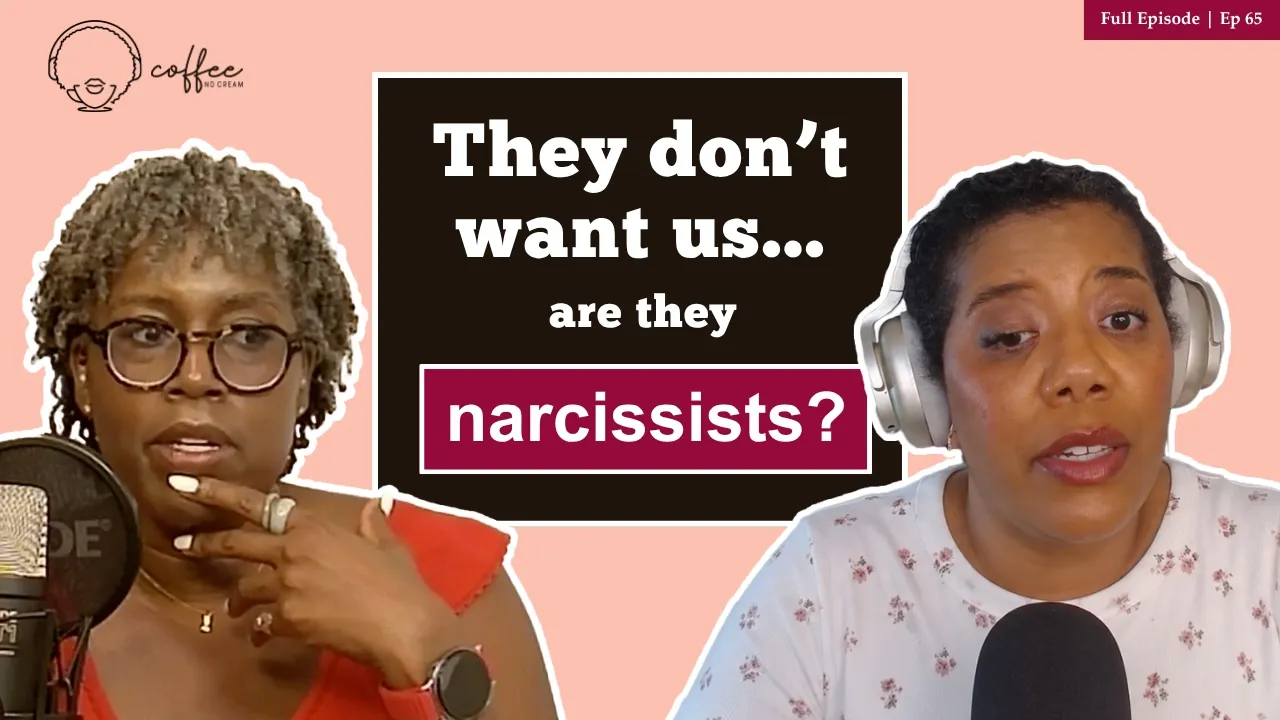
In this episode of Coffee No Cream, Erin Braxton sits down with psychologist Dr. Natalie Jones for a provocative conversation about narcissism, dating, race, relationships and some of the warning signs Black women may be overlooking.
What does narcissism actually mean, and how is it different from the way we casually use the word? Dr. Jones breaks down narcissistic traits and explains how she believes race, status and proximity to whiteness can become intertwined with narcissistic behavior. That leads to one of the biggest questions of the episode: when a Black man specifically rejects Black women while placing women of other races on a pedestal, could narcissism be part of what’s going on?
The conversation goes much further. Dr. Jones shares what her work in corrections, forensic psychology and domestic violence has taught her about manipulative behavior, red flags in dating, pathological lying, control, verbal abuse and the moments when unhealthy relationships can become dangerous.
Erin and Dr. Jones also talk about why Black women may sometimes stay too long, the pressure to “build a man up,” the idea that there is a scarcity of Black men, and whether Black women have been given enough examples of what it actually looks like to be loved well.
This conversation includes strong opinions and some uncomfortable subjects, but the message for Black women is simple: pay attention to what you see, stop explaining away behavior that concerns you, and go where you are loved, celebrated and appreciated.
CONTENT NOTE: This episode includes discussion of domestic violence, sexual offending, pornography and abusive relationships.
Listen to the Audio
Dr. Natalie Jones (00:00)
When I stick my penis in whiteness. That gives me power and superiority because now I have overcome an oppressor with people who crave power. There is a racial component to it. I don't trust people with all white friend groups. If you find yourself feeling sorry for a man that's your cue, you n you've you've stayed past the expiration date, men will leave you with babies to saddle you up.
keep you busy, right? So you can't go out and live a life on your own. That way they can come back and dibble and dabble with you whenever they want. The top predictor that things are really gonna get ugly for you is verbal abuse.
Erin Braxton (00:41)
Basically, you're saying that desire to just partner or be with maybe a white partner could be considered a form of narcissism?
Hey everyone, welcome to the Coffee No Cream Podcast. My name is Erin Braxton, and I am the host of Coffee No Cream. Here on Coffee No Cream, we are unapologetically dedicated to black women, and we share what I like to call coffee no cream moments. Those are those things that happen to us black women in business and in life just because we are black. But today, less coffee no cream moment and more just public service awareness announcement.
we've got Dr. Natalie Jones. She is a psychologist. She is so interesting. She's got so much information to share. She has worked in the prison system. She has worked with black men. She talks about narcissism a lot, the dangers that women can face and dating and relating and trying to be out here in these streets. I have been watching Dr. Natalie on TikTok for some time.
And I just truly enjoy enjoy her videos. I enjoy her her her plethora of information. She's got good stories, wisdom when it comes to dealing with certain personality types. And as black women, we are needing to pay closer attention to some of the things that are going on out here in Dr. Jones.
is joining us today to talk about narcissism and how it plays a role, how we see it, her perspective, and this woman has the experience to back it up. So super excited she's here. Before we get into it though, guys, I just want to ask that you please like, please share, please subscribe to the podcast, and give me a thumbs up, let the notification bell not have the X through it so you you're you're alerted every time a new video comes up.
And leave me a comment. You know I love that. We've got a Facebook group, we've got the free educational resources, all the things. So let's just get into it with Doctor Natalie Jones. Welcome, Doctor Natalie Jones. How are you today?
Dr. Natalie Jones (03:13)
I'm doing well. Thanks so much for having me. I'm excited to be here.
Erin Braxton (03:16)
I am excited for you to be here because I have been watching you guys, I've been watching this woman's TikTok videos and she's got the most interesting study or stories and and and tales to tell of everything that you've seen as a psychologist. So tell us a little bit about yourself. Tell us about your background and let everybody know who you are if they don't.
Dr. Natalie Jones (03:40)
Yeah. Absolutely. So I'm Dr. Natalie Jones. I I'm a podcaster. I'm a professional writer, author, I'm I guess you you know, a therapist by trade, I guess. and you know, so and and I do a lot of different things such as public speaking. I I do work with the courts, and a lot of the work that you've heard me talk about. I I mean I've done a lot of
Well, not a lot, but a a number of true crime stuff as well. So television, podcasts and things like that related to forensic work, true crime. and you know, on TikTok I talked a lot about my background in in working in the correctional system or working with inmates, specifically sex offenders and child predators. so trigger warning for anybody who's listening to that.
And you know, just about narcissism, mental health, being black, being black in the workspace. so a lot of different topics which are personal to me, things that I've also worked professionally on with clients, also with corporations on, you know, y you name it, I've I've done a lot of lot of good things and hope to do more.
Erin Braxton (05:05)
Very nice, very nice. Well, I know you've worked in the prison system. and you say you you've done a lot of work in the courts. So I wanna get into that. I wanna say what's that like, but I I wanna roll back to the word narcissist, okay? Because we've heard that word a lot, right? People use it, it's just like, he's a narcissist, she's a narcissist. So
Can you explain the meaning of the word narcissist and then we're gonna talk about what that how narcissistic I would say men mainly impact black women and some of the things that you've seen. But just first explain narcissist because it's so used.
Dr. Natalie Jones (05:48)
Yeah, I think it there's a way in which society uses it. and when society there's like the society way that people use it, like when you when you talk on podcasts and things like that versus like the clinical you know, definition or criteria that we're looking at. So when we're talking about the buzzword that society is using, a lot of people are using it in the context that someone is entitled, they lack empathy.
and they've they pretty much are very self-absorbed and prioritize their needs over mine, right? And those are certainly narcissistic traits, but when we when we look at someone who has a personality disorder, usually they have the five out of nine characteristics, which is that they lack empathy, there is that entitlement there. they believe that they are special and should be only aligned with like special.
people. so there's you know, the grandiosity, but also being extremely self-absorbed. so that's that's kind of what we're looking at. There's also, you know, you know, even clinically, when we're looking at NPD or just narcissism in general, there is a range of narcissism. There's what we call
Healthy narcissism, which most of us have, where we have a healthy form of self- self-esteem. Like, you know, maybe like when you you get on this podcast, you're like, ooh, you look at yourself in the mirror and you're like, damn, I look good. You know, I got it going on, you know, and I I feel really good about myself. And that's a healthy form of narcissism where you feel really good about yourself. and you know, people will say fall in love with yourself or treat yourself well, right?
And so that's a healthy form whereas we have the extreme form, which is where the rules don't apply to me. if something if I like something or if I want something, I'm going to take it by any means necessary. it doesn't matter who I hurt. I don't care about boundaries. I don't care how you feel or how my actions are going to make you feel. I'm gonna do what I want and I don't care about the consequences of that. And so that's
That would be the more extreme form and I'm I'm simplifying it, but you know, that that's what we what we think about when we talk about narcissism. When we think about when we think about narcissism in the black community, it's it's very it's very interesting. There's a lot of people that I can relate to, but I think also to you know, the race factor.
comes into play, which it doesn't necessarily really come into play in the clinical text, but in in real world it does because there is a superiority complex. and often in the black or brown, you know, person of color community, whatever you identify with, a lot of people associate being white adjacent or as close to whiteness as being superior.
Like there's racial superiority, right? there's also misogynoir, right? And with misogynoir, you have you have people that don't really like black women. We're considered the bottom of the totem pole. we are considered the one that has to do all the grunt work and should never want anything for ourselves and then be punched down on, right? So you have like
you know, that's wh when you when you see people online talking about black women are this, black women are that. I don't want no black woman 'cause they're aggressive and they're hostile, they're angry and they talk back. I prefer a white woman. like I was watching a comedian the other day, he a mojo. He was doing stand up and you know, some white white woman stood up and said something. And I forget what she said and and then this black man jumped up.
And he's like, Watch all you talking to her and Mojo was like, You need to check your your woman, man. And he's like, She's special. Don't talk to her like that. And so the comedian asked him what makes her special? And he's like, She's white. And he's like, What makes your woman special to you is because she's white. You know, so it's like it's almost like, you know, having a being white adjacent or or whiteness is like it's like having the brand new Jordans. You know, it's like
Yeah, you know, I'm clean, I have arrived, I have achieved a certain status, doors have opened up for me, and now I don't want to be associated with my blackness anymore or anything that reminds me of it. At the same time, when these same people fall down hard on their luck or things aren't going well with them, so a good example would be the Shannon Sharp incident, where he got in trouble.
The first people that they run to is the black woman to save them and love them and bring them back. Right? So we are the person that we are the the we are the people that they will use when they want to get back on their feet. and this is something that I've worked with a lot of narcissistic men on, a lot of black male narcissists with in prison.
You know, a a common thing that they would say, We we'll never marry a black woman. We'll never do that. We might have a baby with a black woman and and you know, a black woman's gonna take care of us, but we don't want to marry that. So and the idea ideology behind that is like I'll I'll d I'll waste my time with you when I've got nothing else better going on, or when I ain't got no money, I'm not where I wanna be in life. But when I have arrived and I've got resources and and you know
My pockets are feeling full and I wanna spread myself around and I I'm feeling good about you are not what I wanna look at. I wanna look at yeah. Yeah.
Erin Braxton (12:05)
This is interesting, okay, because you know, I never know how these conversations are gonna go. Right. so when you see that, because even in the prison system, you've got a whole ass criminal, okay, who, you know, is saying this and and and no I guess no disrespect to criminals. Like you think we think, I think as black women, I wouldn't have thought that was the mentality.
Inside you know of
Dr. Natalie Jones (12:37)
Yeah,
absolutely. We think it's it's
Erin Braxton (12:39)
Athletes or the businessmen, you know what I'm saying, once they've achieved a level of status that that's perhaps the way they think, I would have
Dr. Natalie Jones (12:49)
But
if you think about an athlete and a businessman, if you think about an athlete and a businessman, what do they have? They have a big, huge ego. And a lot of times athletes, which I have worked with professional athletes too, professional athletes get into trouble all the time. Right? And they think that the law doesn't apply to them. but they get into trouble all the time. But there's also, you know
Which I'm planning on, you know, maybe talking a little bit more about this, but I do think like when when you think about criminal offence offences, but especially with people who crave power, there is a racial component to it. And that's not really you know, that's not really something that's talked about in the textbook. So like when I worked with rapists, for example, and I've worked with them, you know, my career span ten years now, working with them.
when I've worked with black men, and they they have that desire for power, a lot of them will look at pornography or sexual material that's based in whiteness or that has race play attached to it. And again, because their ideologies are attached to I can achieve power when I stick my penis in whiteness.
That gives me power and superiority because now I have overcome an oppressor. You know, and so there is that lusting after that purely for the fact that that person is white. And no disrespect to any race out there. I'm just telling you you know, based off of my experience. and it's not to say that they won't attack anybody else, but what they're craving, what they're studying.
Is how can I be as close to whiteness as possible?
Erin Braxton (14:44)
So that can play out in a sexual crime or a in a partnership.
Dr. Natalie Jones (14:49)
It can play yeah, it plays out in a number of ways. It could play out in a number of ways. Even how they show up at the job, how they show up at church, how they show up in their community groups, because you know, some of these cases here recently, like you know, and I I won't say any names 'cause these these are cases that are that are recent. and so people can be very sensitive about But when you look at some of these cases where you have black people but they have all white friend groups.
What's really going on? Yeah. What's really going on? You know You know, so you have to look at that.
Erin Braxton (15:26)
And and it's so it's so interesting 'cause we've talked about, you know, I know you're out in Los Angeles, right? And
Dr. Natalie Jones (15:35)
Well in the in the California area right now.
Erin Braxton (15:37)
California. So
yeah. I l I lived in LA for fourteen years, right? And you know, I'm back in St. Louis now. And you know, I grew up in a predominantly white area of town, only black kid. Which
Dr. Natalie Jones (15:52)
Mm.
Erin Braxton (15:53)
was okay until you get to a certain age and then there's a natural I fell, like at least in my generation, a natural separation. There was always one or two out there who just
They wanted to be white, or you could tell they they felt more comfortable. I don't know how this could be, you know, with but as white girl as I talk or whatever people want to say, I knew. I just knew and I have I have all sorts of friends, lovely, wonderful women of all races. But yeah, that's very it's it's just so interesting to me when you don't want any.
black friends. Like I was in California and I would tell my Asian girls, my white girls, I'm just like, listen, I miss black people. I do. Because if you're south of Wilshire, you know, then maybe you'll see more black people. If you're north of Wilshire, you're not seeing a lot, you know? It's very different than being in a Midwest city where there's a very southern mentality, right?
Dr. Natalie Jones (17:03)
Absolutely.
Yep. Absolutely. Absolutely. And and you know, you I don't trust people with all white friend groups. because of that a lot of that centering whiteness. because a lot of times when people have all white friend groups, they're willing to overlook disrespect. They're willing to overlook racism just to be white adjacent. And and
Don't get me wrong. There's nothing wrong. If you're white, you're white. I don't have anything against white people. But I'm talking about people within my group, that are trying to achieve something that which they never can, or you know, being self hating, not loving themselves to appreciate their own skin or their own people within their own skin. and and I'm not there's also other folks that, you know
will say that I've been traumatized so much by my own group of people, I don't like them anymore. So I I have people that say I've been traumatized by so many black women or so many black people, I don't I don't like black people as a whole anymore. So anybody that's willing to make those broad stroke generalizations, you know, because the truth of the matter is no matter how much they're fighting to be white adjacent, they're still not really connecting with that group either.
You know what I'm saying so so they're disconnected. And I think when we when we think about narcissism and things like that, at the core of narcissism is feelings of emptiness, not really having a personality. So you're just sort of grabbing on and picking up cues from everybody else because they're a chameleon. They blend with w whomever and wherever they go.
Erin Braxton (18:52)
So just like this is really good. So basically you're saying that and and and this might sound extreme to those who have chosen to partner or be with, but that desire to say have compl not just assimilate, but to just partner or be with maybe a white partner.
Could be considered a form of narcissism?
Dr. Natalie Jones (19:25)
Absolutely. Absolutely. Absolutely. Especially you know, and this is you know, we've seen this time and again. So you know, and I d I don't care. You know, I don't I don't have any vested interest. So I want your aus audience to know I don't care. Love who you love, date who you want. It's Dr. Jones is gonna go to bed at night, I'm gonna feel fine. Right. Right. So and I'm not I'm certainly not trying to shame anybody and just saying that. But you do have people out there that says, I'm not gonna date her 'cause she's not white.
Or I I want to date her specifically because she's white or because she's Latina or because she's Asian. or they'll say something again that's very white adjacent or just biased and saying like, black women have attitudes and they're and and you know, they're just ghetto and loud, but I like my Latina spicy.
I like my Latinas to talk shit to me. You know, so you'll hear you're you're basically ordering the same thing but in a different package. But you're saying you're condemning one simply for the color of her skin, but you're saying you like the same traits. I just don't like it on you. 'Cause you're black.
Erin Braxton (20:39)
Yeah, I dated a guy,
I think he hated me. No. I he just didn't.
Dr. Natalie Jones (20:48)
Right.
Erin Braxton (20:50)
Yeah. But it was when I was in California and I key low-key liked white girls. He had been married to a white woman because she paid him just to get the you know, the green card or whatever. But as soon as that time was up, she left his ass and he still talked about it all the time. And that's what he wanted. That's what he really, really wanted. You know what I'm saying? And
You know, I want to talk about this because you know the you know, obviously we're here to to help and uplift black women and men and the wrong man and the wrong situation can be a huge disruption.
Dr. Natalie Jones (21:35)
But I'll even take what you just said. I'll even take what you just said. He he liked that white woman because she did this and that for him. That is a hallmark of a predator. Well
Erin Braxton (21:44)
He no, she was she was getting the green card from him, right? Yeah. So she needed to marry somebody to be in this country. And he married her for that. Okay. So I don't know if I said it the other way around, sorry.
Dr. Natalie Jones (21:57)
Yeah. Okay. No problem. Yeah.
Erin Braxton (22:00)
Yeah, so yeah, but you could tell it's like mmm there there was such a something wrong with him. And you know, some of his family friends, old friends came to visit him from Tennessee. They didn't never they never knew he had been married to this white girl. In fact, one of his friends was like, you I know you don't mess with white girls and I was just like, Don't you? You know what I'm saying? So, but yeah, he just was
He was not attracted to me. Like he thought I was attractive, but he didn't want me, kind of thing. You know what I mean? He just we managed to get together, but then it was like then it's just like he just didn't then no, he d he wasn't even attracted to me at that point. I don't even know what he was doing. But yeah. And I've noticed that, like just in guys, just listening to friends, guy friends talk about, you know, it's like, you don't really like us. You know what I'm saying? It's just like
Yeah.
Dr. Natalie Jones (22:57)
Yeah, and I mean th the they might not even be attracted to women at the end of the day. because again, sometimes, you know, that's the other thing. Is like again, just because someone says that they like white women or they want the the status that comes with whiteness does not mean that they necessarily like what they say they like. They just want what they feel like is the perks that come with that status or they want
You know, 'cause there's you know, and again, no disrespect to anybody, but you know, a lot of a lot of the talk or the rhetoric is also too around passivity. so, you know, th they're not as sassy or, you know, as masculine or as dominant, meaning that they're gonna let me get my way and do what I wanna do with no questions asked, which is very predatory. you basically wanna run amok.
And not have any responsibilities or boundaries and you want to triangulate races to do it. and it just, you know, you kind of you kinda catch on to the con game pretty quick 'cause it's all the same playbook. there's nothing, you know, you know, like earth shattering about it. It's really all the same. It's all word verbiage. It's meant to triangulate.
and you know, try to help someone who is confused take advantage of other people and pit races against one another or, you know, do that because I I feel like that you know, some of that came about with Kim Kardashian. Kim Kardashian I think was the first one I think that really caused a lot of outrage on her show when she was dating black girl, you know, some of those comments that would be made and things like that. But
You know look at what's happened. She found out.
Erin Braxton (24:57)
Yeah, well yeah.
Dr. Natalie Jones (25:00)
You know Yeah. Yeah. Yeah.
Erin Braxton (25:03)
Okay. So I wanna I wanna h have you help us to understand some of the signals that we can see. Cause you do these kinds of videos, right? Where, you know, like my situation, it's just like, no, dude, I don't even think you like black women or you know, some of the little things that w women can pick up on and then I'm gonna get into some like deeper, like more darker stuff that you
you always talk about that's really quite fascinating. But what are some just like quick signs, you know, because so many black women want a black man, right? Which is unfortunate because so many black women men don't want us. And we're s not as quick to step outside, which is we're gonna talk about that in a minute too, of how it plays a role with us dealing with some of these
guys that are just how the hell do we end up in this situation? Maybe because the the pool is too small, you know? but yeah. So what are what do you feel like are some key just things, not necessarily the dangerous ones. Like they're all it's all danger. We're gonna get to danger, but that we should look out for when even just being in presence with other
I would say black men and I don't mean to bash black men. I'm just saying 'cause I love black men but sometimes I don't.
Dr. Natalie Jones (26:35)
Absolutely.
You know what I'm saying? Yeah, absolutely. Yeah. I have a father, brothers, uncles, a grandfather and all that. So this isn't this isn't a man hating or black man. And not to mention I've spent the majority of my career working to help black men and other other races as well, but mostly black men when I worked in in corrections. well I think one of the first red flags is red pill content.
red pill content has taken ex explosion over the years where it's like, you know, women are this, women need to do that. you know, that Kevin Samuels rhetoric, you know, the the pot the podcast bros, you know, that kind of stuff. so I think that's number one. I think number two is you always kinda wanna be a little bit more I don't want to say on guard, but definitely inquisitive if
the women he's dated in his past do not look anything like you. so you know, and then third would be if if you feel sorry for him. If you find yourself feeling sorry for a man, that's your cue. You need you you've stayed past the expiration date. The moment you feel sorry for whatever reason, it's time to go. because and in
The y you feeling sorry for him will ultimately be the downfall of your relationship because he's gonna hate you for it. and he's gonna get you back for it. Because you know, when he's when you're put in a position to feel sorry for a man, he doesn't feel good about himself and he automatically thinks less of you for not feeling good about him. That's just that's kinda how that works. so you need to pick pack up your things and go. I don't y you know, whatever the situation is.
If there is if if he's down on his luck, he's out of resources, you know, and if he's down on his luck, he's out of resources and your concerns about the relationship or about him continue to fall on deaf ears. So he's not listening, he's not attempting to listen, he's not attempting to work it out.
Or he's offering up an excuse but he's still not being productive. essentially you're taking care of a boy, another child, and he doesn't care. and he's you know, he knows that you're going to continue being his mule and he doesn't have to do any work. so I think that's the other thing. I think next when you if if he doesn't have a good relationship with his mother, if he doesn't respect his mother
grandmother or or the women in his family or whoever raised him, if they don't have a good relationship and he hasn't done any of his own therapeutic work for a number of years to reconcile that and to heal from that. You don't you don't want to step into that. in the in the same token is if he's also it's super enmeshed
with his mother, his mother has to tell him what to do. initially it can seem sweet, but men that I've worked with like that usually have growing hatred and contempt and resentment for their mother, which they can't express to her. So guess who they will give that to? That is going to be you. So those would be some some quake signs. I think other also too if you if you're a good time girl
You're a fun time for them, but not a long time. So if the if they're offering up any and every excuse, I c you know, I can't marry you, you know, it you've run I I think I think the biggest red flag right now and the thing that absolutely concerns me and I I wanna say this as respectful as possible, are black women who are having children with these men, but they're not getting married.
Like that is concerning or marriage is seen to be harder or more complicated than it is to have a baby with someone. Like I'm I'm not sure when and why that became a thing. but you know, and and I'm not judging people, I'm just saying that like when people do this, you know, this is this is strategic. because a lot of times, you know, men will leave you with babies.
To saddle you up, keep you busy, right? So you can't go out and live a life on your own. That way they can come back and dibble and dabble with you whenever they want and not commit with you, but they'll go wipe up somebody else. you know, after playing around with you for thirty years. You know, they'll they'll they'll f they'll wipe up somebody else within three months and you'll be sitting there with kids and nothing else to show for it. Yeah. So be careful with that. Yeah.
Erin Braxton (31:43)
explain explain really quick. you said the first thing on your list was men who are consuming rel red pill content. Can you explain why that's an issue? Because it
Dr. Natalie Jones (31:56)
Reptil
yeah, it's very misogynist. It's misogy misogynal wire and I think men who consume it honestly are on the down low. so I definitely think that like a lot of men who consume that content, like women should be beaten, women ain't shit, you know, women are this, they're that. All that like rhetoric that hate stuff around women, they don't like women. and you know, if you don't like women, what do you like? That's also something that's very common.
And with men in jail. Like they beat women. They hate women. And I'm not saying all of them, but a lot of those types of men are in jail. And what are they doing in jail? Mm-hmm.
They're with other men, right? and so a lot of them are or you know, there can be some exceptions and the exceptions are usually men who hate everybody, which is very rare. Like I hate everybody, I don't want you know what I'm saying? Like usually
Erin Braxton (32:51)
Yeah.
Dr. Natalie Jones (32:52)
a manipulator is gonna wanna latch themselves onto
But also too, with a manipulator a a manipulative man that hates women, the one thing you have to realize for me, in my experience, when you're talking about a manipulator, an opportunist, they don't really have a sexuality. They go with whatever is going to supply them with what they need, right? So if they need to be heterosexual, I'll be heterosexual. But if I need to be gay, I might not be.
claim that, but I might sleep with a man or two or ten if he's doing what I need to do and making life as comfortable for me as possible. So you're sitting in rooms with other men listening to content around hating and bashing, harming women. Yeah.
Erin Braxton (33:47)
Mm. So let's talk about when we come from these difficult situations versus when they become dangerous situations, right? A lot of your content is just it's just like kind of jaw dropping, like, what? Like and and I told you you know, some other things, but you know, before we started recording when I was
And I'll I'll have you bring it up, the whole blue magic thing that I just don't think a lot of people know about. But when you're dealing with narcissistic men or even narcissistic women and, you know, in relationships or whatever, when it becomes very dangerous, particularly for black women, because I ask this
Because in this and and I don't want this to sound bad, but I feel like a lot of black women in our effort to choose a black man, because we want a black man, we're quite forgiving of a lot of things because of what we perhaps witnessed, what we're used to. okay, he was in jail. You know, we had an uncle in jail or a cousin in jail or even a father or a brother in jail. So we don't see that as
such a problem, right? Maybe that's why we're we're more forgiving. You know, like if somebody tells me, yeah, I I was in jail for a minute, this guy tried to talk to me when I got back here, he was in jail for something.
Dr. Natalie Jones (35:26)
Why women are doing that. I don't I don't get that. Like because when the shoe is on the other foot, they're not doing that for us. So I I think women need to like maybe like look at that a little bit more. I mean, I hear what you're saying, and yes, that is a thing. But women need to start being a lot more black women need to start being a little bit more a lot bit more selective and you know, because now you got these men that are going on these podcasts. I don't want a woman with children. I don't want a woman with a certain
Erin Braxton (35:54)
Got five. Yeah.
Dr. Natalie Jones (35:56)
Right, right, right. When they've got like all these but you know, you have you have people that are basically going on national podcasts, national dating shows, talking about black women in this manner. You gotta you know, you you have to start looking at that and like saying, you know, if they're comfortable enough to go on TV, 'cause when when they're doing it like that
You know, they're comfortable talking about it on a podcast just like this or you know, even bigger platforms. They've been doing that for a while and they're doing it in mixed company. Mm-hmm. So what does that tell you? Right? They got no problem using you for what you have to offer, but they're basically telling the world that you're not worthy of these things. So women need to really like I I think they need to really look at that and say, you know what, I need to be a lot more selective.
on who I want to share my life with. And this is nothing against incarcerated people, right? Because I do believe people can be rehabilitated. I do believe that people can change. However, I do think that women, black women especially, need to take better care of themselves and take better care of their children and their future by being a lot more selective in s what they will entertain.
Erin Braxton (37:19)
So yeah, so let's talk about when the narcissistic tendencies and what you're talking about becomes actually dangerous, not just psychologically dangerous because you're dealing with someone who truly low key doesn't like women or low key likes women of a different color. They don't even really want you or they're just using you for physical pleasure or whatever like that. But talk about let's talk about situations where
these types of personalities become very dangerous, particularly to black women, because I think a lot of things just kind of get played down just because of just what I was just talking about.
Dr. Natalie Jones (38:03)
Yeah. Yeah.
Well I think I mean going back to the the first group of things, that is really dangerous. And the reason why I mention those things is because if a person's gonna do the first group of things that I talked about with you, mm-hmm, what else are they gonna do? That makes it easier that much more easier for them to put their hands on you. It makes it that much more easy for them to go out and sleep with people and not feel like they owe you the respect.
your body the respect or the decency to be safe and protected, bring back home things that you cannot get rid of in your own body. Have children outside of you. But I also think other things too would be the anger and especially I think the the the top predictor that things are really gonna get ugly for you is verbal abuse. so when you have people that become verbally abusive it
doesn't take much longer after that for things to escalate into physical. I think you know w you know when you when you're in a relationship with a narcissist, they like to be in control and they like to make all the decisions. When they feel like they are losing control, that is the most dangerous time. so there's a couple you know a lot you know
And I've worked as a domestic violence counselor for a long time. But you know, l most people know it's it's dangerous, you know, the most dangerous first two years after a woman leaves a relationship. But I would I would go out on a limb and say that there's other dangerous situations which aren't talked about enough. I think other dangerous situations would be when a woman gets pregnant. I think that's also one of the most dangerous times.
in particular if he doesn't want it. if he doesn't feel like he should have to take care of it. I think that's a lot of black women have met harm in that way. But also too, when you f when you have s when you decide to stop being your purse a nurse or a caregiver or something, like when you I'm not taking care of you and you're doing all the work in this relationship anymore like you either need to, you know, get up off your butt and pull your weight.
That's also a very dangerous time. and you know, you have to remember somebody with nothing doesn't care about making sure that you've l lost everything that you've worked hard for. So when they start, you know, doing property damage. I did a post, I think it was yesterday or the day before, when they pull a weapon on you. Yeah. Or they they start brandishing weapons of any kind, for any reason.
That is a a warning sign. veil threats. If I can't have you, nobody can, you better not ever leave me or I'll you know, that kind of stuff. you know, so just threat threats arm your children or go after people that you care about. that's also something. you know, I think the other thing would be, you know, which is something I saw, you know, when I used to work in retail a lot.
is when they come up to your job and they wanna show their ass on your job. so, you know, cuss you out. I've seen people I've seen women get hit on the job, you know, all kinds of stuff. Right in front of everybody. And I you know, it was a lot of traffic and nobody said or did anything. So I think that's another thing if if people are willing to do things publicly to you, like in front of on your job or in front of your family and your friends.
And doesn't care. I I think to me that makes a person ten more times ten times more dangerous if they're willing to do things in broad daylight and not care about the cop that take that's like a person I don't care anymore. I don't have any self-control and I don't care who sees it. That is so dangerous. Cause most criminals are like, I'll do stuff, but I don't want to get caught. Right. You have somebody that says I d I don't care if I get caught, I don't care who said saw or what
You know, I'll kill you, especially two if the police are there 'cause I've seen situations where police have been there. They don't care. That's very dangerous. So
Erin Braxton (42:31)
So okay, so that's like when you go and you they're at one hundred, okay? What are some of the little signs that you know y we can pay attention to or we can share or you can share that could indicate, you know, you said of course red pill content and things like that, but what are some of those things, those little Natalie, Dr. Natalie Jones things, you know how you you that you could share that could
Clue you in because nobody's gonna just get with somebody who just is crazy from jump. You know, they have to get in there, right? So
Dr. Natalie Jones (43:10)
I think you know, one thing that can be minimized or dismissed is pathological lying. So when you have somebody that lies about just for no reason to lie, is just lying all the time. you know, lying is very easy, like breathing. that is somebody who does not want you to know them. They don't want to reveal their true selves to you. And I think that's an extremely dangerous person.
You know, people who are living a double life kind of go into that. So if you find out somebody has told you something, like they presented themselves as single, but they're really married and they've lied about that kind of stuff. So I think that that whole double life or, you know, maybe they've had a child along the way because living a double life takes so much effort and lying. Not only that, but it costs money and just you know, energy to kind of do that.
let me see what else would be I think go ahead.
Erin Braxton (44:16)
Say on the double life though, do you think that we just ignore those signs? Because usually there's some indicator. You know, I've heard situations where people really just didn't know. But do you feel like it's that easy to fool if you're living a double life?
Dr. Natalie Jones (44:38)
think there are people who who don't know up to a certain d extent. So a good example would be like you know, and they've made lifetime movies about this. If you have a job that's like on the go a lot, such as a long haul trucker for a pilot or something where you're traveling and it's kind of easy to sort of explain away like I'm you know
I'm in you know, I'm I'm flying for the next I don't know. You know, stuff like that. I think that's to a certain extent. But I do think there's a lot of there are people out there that may you know, I'm I'm so in love with this person or this person has been good to me. I would never like believe that they're lying. Even if like little things don't add up, you're kind of there are some people, women that are willing to sort of explain away and and and you know, kind of make up the difference in their mind.
but I also think, you know, there are like double lives that people would be like, No way. So an example of that would be like down low culture. Like there's a lot of women who are with men that are like, there's no way he's like having a full blown relationship with I like I can't like wrap my head around that. You know, so there there are some times where people just refuse to believe that or they want
very much to believe in what they have. So a lot of times when you know, when I've counseled women, you know, if they've if they're married and they got kids, there are a lot of women out there, but he's a good father and I'm not like we have kids together, so, you know, that's like that's like their dream and they don't wanna disrupt you know, what they've got going on as far as their family life goes. Because we're so enmeshed. We've got property.
We're we're locked like we're locked in. Yeah, sure he's got an attitude. Sure, he's not home on Tuesday through Saturday, but like we have so much. And so there's so many people that for you know, various different reasons that are caught up in an identity or they want to keep their family together and not rock the boat. just just so various different things that are going on. Or they don't wanna be alone or they don't want to start all over again, or they just don't wanna believe it.
You know, so that that can happen and sometimes they might hear it from their family members. you know, family members might tell you, Hey, I think so and so is sleeping with another man or I think so and so has got something going on. They don't want to hear it.
Erin Braxton (47:15)
Yeah.
Dr. Natalie Jones (47:16)
Matter of fact, they don't even want to hear it and they'll go back and tell the partner who's doing all that, Guess what so and so said? Can you believe they said that to me? And yeah, baby, they're just trying to break us up. You know they jealous of us.
You know, that kind of stuff. And it's like, you know, they'll actually go back and they'll blow up the spot with you. The person is trying to protect them before they will with the person who is deceiving them. And it happens all the time.
Erin Braxton (47:42)
Do you think the scarcity, I would say, of black men in the community causes black women to be more accepting of some of these things, or do you think it doesn't matter across the board?
Dr. Natalie Jones (48:00)
I don't think it does. I don't think it matters. I mean, because you know the scarcity of black I d I mean, you know, I I think you know, one thing that black women have to realize is there's not there's not a scarcity of men. And I think with any woman, black, brown or otherwise, you need to go where you were loved.
You know, and I think that's what needs to be taught because there's a lot of women that are hanging on with men that don't love them, that don't like them, and don't even want to be with them except for what they can provide, but they're not being loved. They've never been properly hoarded. You know, they deal with bullshit day in and day out. You need to go where you are loved, you need to go where you were celebrated.
And you need to go where you are appreciated, where you are adored, you are doted on, and you will be, you know, you will get the life of your dreams because, you know, it's not fun waking up after ten, twenty, thirty, forty, how many ever years with somebody who hates your gut and feeling like, damn, I never been with somebody.
that loves me or that treats me well and I don't even know what that's like. But I have hung in there with a black man though. You know how crazy that sounds?
Erin Braxton (49:34)
Well, that's why I'm asking you. But that's why I'm asking you because we are s the least likely to date out. You know what I'm saying? Like every other race dates out. So that's why I'm saying, do you feel like 'cause some of the stories I hear from my black friends versus my other race of friend I had a girlfriend tell me, she caught well, we're not friends anymore. And you're gonna hear but
She she caught her man watching bestiality porn. I'm sorry. That is if that isn't a red flag, I don't know what is. And then she was having trouble getting him to be interested in her. And it's just like, why are you putting up with this?
Dr. Natalie Jones (50:21)
What are you doing? Yeah. I think I I the one thing I the one caveat which I've spoken about about this is I don't think black women have enough role models of what it looks like to be loved properly. Mm. You know, back in my day we had the Cosby show and that was like great black hope and I did a dissertation on that and for a lot of black women my age or a little bit older
That was the great black hope, you know, but they were being loved on, they had a father, they you know, they were well to do, they went to college, you know, and so that was like, that was hope, but now we have Tyler Perry, we have other like movies and things where black women are being traumatized and being shat on by the second. You know, so I don't think that black women have enough
role models and see enough messages about what it means to be loved on properly. When you when you think about for me, when you when you look at black culture as a whole, when you look at music, when you look at movies, when you look at just like the images out there, they're talking about money, bitches, hoes, drugs.
And stuff like that, or there's a lot of violence and we're being go we're being drugged through the ringer. Even black adjacent, like Afro Caribbean, you know, you talk about like Cardi B's and things like that. Like you're not seeing images and and I I don't really consider her to be black, but I know that she's she's kind of very entrenched into the black culture. You're not seeing these women being treated well and being loved on properly. And I think that's what's missing.
is like the positive images and the role models and like the examples of that like being shown what love looks like and how it looks to be treated well. So I don't I don't know that necessarily we wouldn't go outside of our race. I just don't know if we have enough mainstream examples of what that looks like and what it takes to like
you know, conquer that or ha ask questions on like, you know, just being able to maneuver family dynamics or just understanding what love is. 'Cause sometimes love can be like healthy love can be staring you in the face, but you'll dismiss that because that can feel foreign to you. Yeah.
Erin Braxton (53:01)
it's so funny you brought up Tyler Perry. I I I I agree. I I haven't what was that? That bla whatever that was about the
Dr. Natalie Jones (53:12)
The bus driver.
Erin Braxton (53:14)
Well, th those are yeah, those, but it wasn't that. It was the one on Netflix about the
girl who got the the butt injections and the the the the it was so ignorant. And they treated the black girls so I I was like, This cannot I can't even I couldn't even stomach it. I couldn't even watch it and
Dr. Natalie Jones (53:37)
And he has enough money now that he can hire psychologists and actually like implement po yeah, writers that have positive role models of like black women. Yeah. But again, you know.
Erin Braxton (53:52)
Very yeah, yeah. That's what we have. Because I feel like in the nineties we had some good, you know, black movies and stuff like that. And I just we don't we don't that's true. We don't have the reper it's the representation. It's the representation
Dr. Natalie Jones (54:08)
The
representation, the over sexualization of of everything. So things have just really gone like downhill. But I do think black women like like American black women, as well. I'll I'll be specific about that 'cause I I can't really speak about what happens in Britain and other you know, other people that might watch you from other countries. But American
black women do not have enough role models of what it means to be properly properly loved by black or anybody. I think you know so I think that's what we need to see more of more of and then people can raise their standards. they can let go of those that old time rhetoric of you gotta build a man up and, you know, hang in there and be right or die and that kind of stuff. You know
you you've I think we need to learn how to work through that collectively as a group and leave that behind. When you when you look at other races, other cultures
I don't think to this day I've ever heard a Arabic man go on a podcast and talk shit about Arabic women or Middle Eastern women. I don't think I've ever heard a Mexican man do it. And I'm not gonna say that those men don't do it, per se, because I'm sure there's some exceptions. But it's not something where I'm hearing that's widestream, everybody that's taking up a mic and sort of
casually do I I don't see it on shows like you know right now the big thing is mar married at first sight and I've I did a po a post maybe a year or so ago black women need to stop going on that show but that's though that's the kind of messaging that we're seeing where black women are just being played with, they're being psychologically and emotionally abused on these shows and they're doing it for entertainment.
Every single season they do that. And it's it's become so comfortable and so we've become a spectacle for clicks and views and I I'm not I'm not a fan of that.
Erin Braxton (56:27)
Well, I'm gonna have to have you back on because we we need to go like I know we're we're limited on time today, but we need to go we could go deep on some of these subjects because I know there's been a lot of controversy about the shows. Like Love is Blind is one that I w I used to watch.
Dr. Natalie Jones (56:45)
Yeah. Mm-hmm.
Erin Braxton (56:46)
Yeah. I don't watch Love Island. I c I tried. I couldn't I couldn't do it. Yeah. I couldn't.
I couldn't do it. You know. Even though the breakout star couple, I do know who they are. But I d I just couldn't I couldn't do it. But I know people love that love at first sight. Yeah. Show show. Yeah. No, you've got a lot of I know. There's so many I have so many notes, but we just we've gotta we've gotta end it. So I've gotta I'm gonna have to bring you
Dr. Natalie Jones (57:15)
Next time. Yeah, yeah. Absolutely. Absolutely.
Erin Braxton (57:19)
Tell everybody where they can find you.
Dr. Natalie Jones (57:22)
you can find me at www.drnatal jones dot com. you know, in my TikToks, Dr. Natalie Jones Cide, you know, Instagram, Facebook, all of that, Dr. Natalie Jones Cide, L P C C all of that kind of stuff. But Dr. Natalie Jones dot com right now is my hub. and then, you know, I'll be launching a new website soon, healing with Doctor Jones.
so we we got lots of good stuff coming for you. But absolutely TikTok, you know, you can find me there, but message me through my website. I'm here.
Erin Braxton (58:00)
Yeah, good stuff. I didn't I didn't get you to do t tell about the blue magic thing, but I mean maybe
Dr. Natalie Jones (58:06)
Ha ha.
Erin Braxton (58:08)
I'll put a link to it in the
Dr. Natalie Jones (58:10)
Yeah, but it'll link to it, yeah.
Erin Braxton (58:12)
Yeah, 'cause that was crazy. If you smell blue magic on him, girl, run. Yes. That's the gist of it.
Dr. Natalie Jones (58:20)
Yeah.
Erin Braxton (58:22)
Thank
thank you so much for coming on and yeah, you'll definitely have to come back 'cause yeah, we could we could talk for a while. We could talk for a while.
Dr. Natalie Jones (58:31)
yeah. Thanks for having me.
Erin Braxton (58:33)
Yeah, yeah. Appreciate you so much. And thank you guys for watching and we'll see you in the next video.