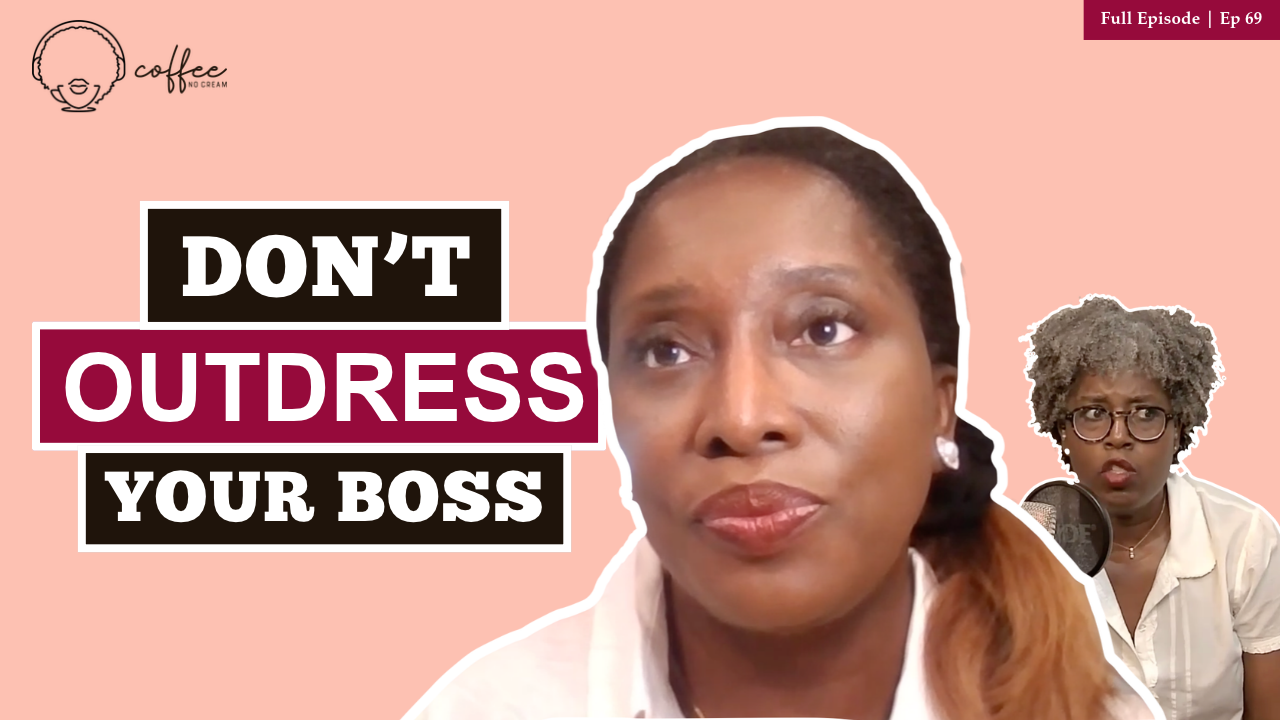
Should you dress down so your insecure boss feels comfortable? Or is that a hill worth dying on?
Tai Robinson is back, and she’s not giving you the fairy tale version. After years as an HR director, she’s watched appearance keep people out of leadership, and she’s lived it too. Every time she went job hunting, she straightened her natural hair. Not because she wanted to, but because her goal was the offer, and she had no idea what the person across the table believed.
We dig into your comments from Episode 66 with Beverly Dines: dressing better than your boss, the “conform or move on” reality, why her blue hair is “cool” and ours gets called something else, the CROWN Act, what to ask when someone pulls you aside about your attire, and why Tai tells employees please don’t bring your whole self to work.
If you’ve ever been told you’re too much, too dressed, or too different at work, this one is for you.
Listen to the Audio
Erin Braxton (00:00)
Can a black woman be too well dressed at work?
Tai Robinson (00:04)
We've heard the phrase, bring your whole self to work. Please don't.
Erin Braxton (00:08)
Even when you're working remotely, what is your recommendation as far as how to present? What are some of the questions that we need to respond with if we're ever met with this conversation that can help us determine if they're on some bullshit or if this is legitimate?
Tai Robinson (00:27)
If you feel targeted, typically there are two options. You conform or you move on.
Erin Braxton (00:34)
Have you been in a situation or seen a situation as an HR professional where appearance has prevented somebody from a leadership position?
Hey everyone, welcome to the Coffee No Cream podcast. My name is Erin Braxton, and I am the host of Coffee No Cream. Here on Coffee No Cream, we're unapologetically dedicated to black women, and we share what I like to call Coffee No Cream moments, those things that happen to us black women in business and in life just because we are black. Today we are talking about the black woman's appearance in the workplace. And I have brought back HR director and specialist expert Tai Robinson, and she is going to
Have that conversation with me. We've had a lot of comments on the podcast over the last few weeks about comments black women are receiving about their hair, comments black women are receiving about their clothing. You know, should women dress up even when everybody dresses down? You know, these are things that are very, very common for a lot of us to hear in the workplace. I've dealt with it when I was in corporate. It's still going on today. And
Not only is it annoying, it's stressful because what do we do? Do we do we dress for success? Do we dress to the best of our ability, or do we downplay it because we're trying to hold on to our jobs? So we're gonna talk about it. a lot of times black women are targeted in more ways than one, and looking good or not can make us targets. So before we get into it, I want to ask that you guys please like, please share.
Please subscribe to the podcast. I really appreciate all of the support that we've had so far. And you know, your like, your comment, which I love, the comments, your interaction, engagement with the video really helps the channel. So let me know what you think. I want to hear from you too. please leave me a comment and let's keep the conversation going in the comments. We have the Facebook group. The link is below. And yeah, that's it. So
Let's get into my conversation with Tai. Some of it might be a little difficult to hear, but we've got to do it. So let's get into it. I'll see you over there. Welcome back, Tai. So glad to have you back on the podcast.
Tai Robinson (02:56)
Thank you, thank you, thank you. Glad to be back.
Erin Braxton (03:00)
Okay,
we're gonna have some real direct maybe
Tai Robinson (03:03)
Maybe maybe
Erin Braxton (03:05)
even a little difficult conversation today. And we're talking about presentation, black women's presentation. Not necessarily fair, not always equal, but we've had a lot of really good episodes in the last couple of weeks and it's sparked some some interesting conversation when it comes to how black women are presenting themselves.
in the workplace. And with you being an HR, an HR director for many, many years, I knew you could bring the insight. So let's just let's just jump right into the first question that I have for you. Can a black woman be too well dressed at work, in your opinion?
Tai Robinson (03:53)
So I I think that it's important to read the room, read the space, understand the culture. I've heard people say it's never too much, but I do think that there are times, there's a time and place for everything, depending on the occasion for sure. But I do think that sometimes, and not speaking specifically for for black women, but I do think that.
It could be too much in certain situations and places.
Erin Braxton (04:23)
Okay, I got a situation. We got a comment from Ripley 3340 on episode 66 with Beverly Dines, who COO talking about presentation, right? Ripley says
What about dressing better than your boss? I'm currently a special education teacher, and my principal and all the teachers wear t-shirt, jeans, and tennis shoes. I was teaching in Europe for over a decade, and as a woman, I just do not own t-shirts. The clothes I wear are just basic work pants, professional tops, and shoes. However, I look so dressed up compared to my colleagues. What should I do?
Tai Robinson (05:06)
Hmm, that's a really good question. I I think that that can be subjective, but I do believe that instead of focusing so much on how others dress, I think we should focus on what's the standard in terms of you know attire. Like what is what is a standard of professionalism that may look different for everyone, and to to be honest, I'm not
t-shirt girl either sometimes when we start to make certain statements is this is is this an opinion or is this an actual standard what is the standard in this workplace is the standard to be to come to work with you know groom wealth great hygiene we should really focus on standards opposed to
this person is wearing a outfit from Target versus this person is wearing an outfit from from Nordstroms. You know. I I just really and truly believe that we should focus on standards.
Erin Braxton (06:14)
So do you think that dressing up more formally than leadership can create perception problems in the workplace? 'Cause 'cause I saw, let me just say I saw somebody did a post on TikTok and anybody who watches me knows I scroll TikTok a lot and they were talking about dressing better than your supervisor. And somebody in the comments was like, That's why I always dress like Harriet Tubman. And I don't know why
That's so funny. But it was like a ton of likes on that comment and I'm just like, I get it. I have gotten comments about the way I dress, especially when my mom was alive, when she was still paying for clothes, you know? And and you know, we are just raised to wanna look good. I remember a w a girl asked me, Did my mom save money because I dress so well? Like when I first got of school. So I'm just yeah, so what do you what do you think about that?
Tai Robinson (07:12)
Harriet Harriet Topman. Wow. So
Erin Braxton (07:18)
That's taking it a little the other direction.
Tai Robinson (07:21)
That that really is. So here's what I would say I would, you know, definitely not conform in terms of of dressing myself down so much where I'm uncomfortable.
Erin Braxton (07:38)
Somebody wrote, this is from Brown Shades C C T R O, I would never dress better than the boss. I would downplay play it slightly. What's the first law of power?
Because that that that ties into the question of should we d ever downplay our appearance to protect somebody else's ego if it serves us in the workplace?
Tai Robinson (08:06)
Think that that has a lot to do with the environment. if it's if it's an environment where where you know people are not feeling safe and they feel that energy, they're going to probably show up that way. If you feel targeted, whether or not you're in HR or in other positions,
Typically there are two options and and this is just the truth. Usually you conform or you move on.
And and especially if you become a target. And especially if that person that's targeting you has some level of positional authority where they can influence your position, your job, or threaten your job. There's usually two options. Either you conform or you decide make the decision. You you know, quietly quit.
Erin Braxton (09:04)
think I think there's a lot to be said.
about what you said, c conform or move on. And I think a lot of times your own ego can get in the way, like who, you know, about this. But the reality is, and as black women, we are d we are we are judged in a different way, right? And if you I Beverly Dines said, you know, when you go from pet to threat and you realize they realize by the time you realize you're a threat it's too late and you need to like move on, you know? So I like that. Like this is
Tai Robinson (09:40)
is it's it's uncomfortable but I I do think that it's the reality that we do live in and right now you know let's face it we're in we're in a crisis black women are in a crisis when it comes to their jobs and and everyone's just trying to hold on there were times where if you thought you know this isn't working for me I may you know these things sometimes you know if if I have to make a choice between
You know, keeping my job and maybe dressing down to make sure that someone else doesn't feel threatened or uncomfortable, I'll probably conform to let me just tone this down a little bit, you know, depending on my my situation, my circumstances. Can I afford to to address this issue? You know, and sometimes, you know, we you know, different generations we respond to things differently, you know.
Erin Braxton (10:38)
That's good
point. That is a good that's a great point.
Tai Robinson (10:42)
And
what what I do love about the generation, the younger generation, we're what, Gen X? Gen
Erin Braxton (10:51)
Mm-hmm.
Tai Robinson (10:51)
X. So they are, you know, more vocal about their thoughts and their feelings and and all of the things. But I think that right now folks are not, especially black women, we're not
really feeling it like we're in a comfortable position where you know you know we have to pick and choose what we're gonna die on the hill for. I'm not dying on the hill about some office competition in terms of you know what I'm wearing to work and and up staging someone. Girl, you can have it.
Erin Braxton (11:28)
Mm-hmm.
Tai Robinson (11:30)
You know, if it's that important to you and you feel that you need to make sure that everyone knows that you are the Queen Bee, I will bring you the damn cape.
Erin Braxton (11:40)
And I think you y y like you said, what is your position? Do you have money in the bank? Can you just quit? Can you just do you have F you money? You don't I hate to tell you, but you know, play along to get along until you can get on to something else. Bottom line, right? Right?
Tai Robinson (12:02)
Wear that t-shirt. Where
that if if that's if if someone's giving you the side eye, every single time you maybe walk in or they're making comments that are, you know, comments to you know talk about your attire, jokingly out loud where
Erin Braxton (12:22)
Not a joke.
Tai Robinson (12:23)
right, and they're bringing attention to you.
Clearly there's there's something there. And so we definitely want to pay attention to those types of cues. But you you definitely, it depends, like you said, if you if you can just walk away, okay. But if you're not in a position to walk away, go ahead and and tone it down, bring it down a little bit, and and you know, you're there to perform a job.
It's not a fashion show, it's not a competition. let me get the job done so I can go home and and outside of work, you can be the most fabulous, you know, dresser that you want to be. You can, you know, whoever you want to be outside of work. But if you know that this is how I have to pay my bills and the person that I report to is insecure, feels threatened by my presence, then
I think that I'll probably maybe conform to that situation until I can make that quiet.
Erin Braxton (13:28)
Alternative.
Yeah. Exactly. There's no point in creating that tent just I hear that, you know, and I know a lot of people watching are probably gonna feel some certain kind of way about it. I get that, but I I hear you.
Tai Robinson (13:41)
If
what's important to someone in the space that I work in is outshining and out dressing someone, have it.
Erin Braxton (13:51)
Right.
Okay, I think we I think we got some good feedback on those those those comments. I wanna move on to remote work appearance. And does appearance matter when you're working remotely? Now we've got a comment somebody wrote, This is virtuoso sold nine twenty-five. This is so true, camera on and showing up on camera, looking ready to work. Do not look disheveled, engaging via Teams and Slack and so incredibly important. This is
This was also a comment under episode sixty six with Beverly Dines because she was talking about camera on and when people come on 'cause I I've been on calls where I'm talking to very corporate organizations as somebody who's, you know, an entrepreneur and everybody has their camera off. So I know that's a big
thing. People just are there but the camera's off. And she recommended having camera on. And even when you're working remotely, what is your recommendation as far as how to present remotely?
Tai Robinson (15:00)
Certainly I I think that number one, when you know, there are days that I do work remote, but I will tell you that I exercise the same standard. You know, I might be dressed a little bit more casually from the waist down, but certainly I will make sure that I'm well groomed for the camera.
We're working. So that standard of expectation in terms of your appearance should not change because you're working remote.
Erin Braxton (15:32)
As somebody
who's worked from home since two thousand seven, okay, before all this COVID and everybody was home, I had to train myself to get ready.
And not be in my pajamas all day. And that and that and that was a train that was I had to train myself to do that, right? Because I was in LA at the time when I first started this and you know, I had a loungewear line and I was wearing my loungewear and just very loungy. But you realize you're not even pulled together to work, to do your best. Yes. To do your best work. So you have to train yourself. So I think you have to treat it the same way. It might not be as
business as you would be if you were in the office. But yeah, I think it's I think it's very important. Like I agree with that camera on hair presentable. Now next we're gonna talk about hair because we know that hair our hair is always a topic of discussion. So I get a comment. Somebody wrote this is from Angel Roman seventy eight. Hair color.
I have wore blonde braids and have been criticized, saying it was not appropriate, but then the next couple of weeks everyone is wearing the same SMH, shake my head. What is your 'cause again, I I just gonna say sometimes it's just not fair. But it's just life.
Tai Robinson (17:04)
I totally agree and and we certainly recognize that oftentimes policies are written to target specifically black women.
The workplace. That is just a fact. I have I remember one company I work for, the policy reference, and it talked about wearing hair color that was unnatural. So when you read between the lines, what's really unnatural, because almost every woman I know, white, you know, Hispanic.
We all wear hair color. We all change our hair color. Hello? You know, right now. So we all, you know, wear hair color. So is that unnatural? But I think that the conversation is really about the hairstyle. You know, we we know that we have the Crown Act here in
Erin Braxton (18:10)
I was just about
to say that.
Tai Robinson (18:12)
And the Crown
Act, that was, you know, that act is there to protect women with natural hairstyles. Our African Americans, men and women with that wear natural hairstyles, whether they're wearing locks, they're wearing braids. We know that for us during the summer, especially here in in Texas, we definitely want to wear braids, protective hairstyles, because it's so hot. And and there are times where we may
Color to our hair, other folks do too. So hair can definitely be a very subjective thing in the workplace because we often see white women typically do not wear wigs. Now they do wear weaves,
Erin Braxton (19:01)
And extensions, clip ins and all.
Tai Robinson (19:03)
sew-ins, all of the things. They wear all of that.
Whereas with black women, we're always asked the question, because if our hair changes this week and maybe next week, my God, you know, what did you do to your hair? There's some some etiquette to be learned about
our culture and our hair and unfortunately like many things we need laws to enforce etiquette for people to understand what's appropriate, what's not appropriate. And but I do think that hairstyles definitely matter in certain workspaces. Corporate America folks seem to be a little bit more comfortable when your hair is like this. And and this is a real conversation Erin because I know that every single time
that I was ever like in the market looking for a job. And if I was wearing natural hair before, I would always change my hair to where I'm wearing it straight. Because I my goal was to get the job. I did not know what what the values are, thoughts of the person that's possibly interviewing me.
And so it's always a very scary and tricky thing when we think about our hair and how we're perceived, you know, with regards to our hairstyles. You know, by the way, I love your hair. You know.
Erin Braxton (20:35)
And But I wouldn't have had
the nerve, and I've said this before, I I wouldn't I wouldn't have had the nerve to 'cause I used to have a little p pixie, like my hair was straight, the little Halle Berry, and that was my look. I mean, when I was in my late twenties, early thirties and I rocked that, you know. And then I decided, I don't know, I was broke in LA and I always wanted to go natural, but I d I don't the the it's a it's a big adjustment
to start wearing your hair natural I think as a black woman because especially if you've been relaxed for all those years and you just have no idea what your hair is gonna look like. I mean I was I think I was thirty seven when I finally went natural. I had had a relaxer on my hair since I was eight. So like they say white women don't know their hair color, black women don't know their hair texture. And this is it's very true. So to work all that out
having to go into work and and try to look like something every single day, it's it's tough 'cause we just didn't know. I I I I am very honest, I don't think I would have I would have been comfortable trying to go natural while I was still working in corporate America.
Tai Robinson (21:51)
Absolutely. There is no question when we are working in an environment where everyone's expected, the standard of beauty is certainly not women with coils. That's, you know, unfortunately, in our country. And it's always been that way. There are so many perceptions that we have to concern ourselves with that no one else, if any I I remember one time, you know, where I remember reading the policy where it talked about not
Wearing like hair colors in your hair. There was an employee that was in her leadership role. She dyed her hair blue. Everyone thought it was so freaking cool. Now it was so
Erin Braxton (22:37)
Woman? Yeah. Yes.
Tai Robinson (22:40)
cool. my god, your hair is so awesome. It is so cool.
If a black woman was to show up to work with blue hair, it's ghetto.
Erin Braxton (22:52)
But what are the rules, Tai? What are if because people will low key complain and things will happen in the office place and you know I wanna hit this from two directions. What I guess it's hard to say what we feel is appropriate versus inappropriate when it comes to wearing blonde braids, right? Is it inappropriate? Not if that's what you like. Is it appropriate
when you're trying to get yourself to a certain level, maybe not, right? Because we are not afforded the same allowances as them. Absolutely. Right? Nobody said anything is wrong with it. It's probably cute as hell, whatever it is, right? And then
If somebody does say something to you or if there are comments made about your hair or if somebody does ask you about your hair because of the Crown Act, then what do you do? You know what I'm saying? Because we know that yeah, certain hairstyles probably can keep you from, you know, climbing the ladder in an organization. Like that's just it is what it is. You know what I'm saying? It's not right. You know, as somebody with coily, kinky
Four, C, whatever you call it, hair. Okay? So I I understand, but I don't work for anybody. You know?
Tai Robinson (24:15)
Yeah, and and and that is definitely a tough tough call. I think that now things are certainly shifting. I have recognized that there are more executive professionals that are wearing natural hair. And so I think that the standard is changing because people are more culturally aware. And so and and it does require education, you know, from our HR departments when we talk about discrimination.
And what does that look like in the workplace? So when when I have someone, you know,
Situations where they've made certain comments, and what I do is I say, Well, you know, I hear you, but I just want you to be conscious of the fact that when we raise this issue, we have to look at everyone, it's all about equity. So if we raise issues about Sue's blue hair and are we're quiet about Sue's blue hair.
And we raise issues about Shanika's blue hair, that's
Erin Braxton (25:24)
Mm.
Tai Robinson (25:25)
a problem. And I am the type of HR practitioner where I
To laws, policies, and make sure that I communicate the risk of you know making certain comments and making sure that those that are in leadership roles understand the ramifications of making discriminatory comments. It's a very real thing, and I'm not saying, Erin, that you know, although we've made some strides that things are perfect now because
Because the reality is that unfortunately there are people that continue to hold those same values. I think that now in this country we're seeing the worst version of, you know, of of the history, the soul of how people think and believe in this country. they're now saying the thing again out loud.
Erin Braxton (26:26)
Comment.
I have a comment. Lena seven sixty-two. I changed my hair a lot, and yes, it came with a bunch of questions, etc. Mind you, the people who ask always dye their hair, have hair plugs, wear extensions, etc. themselves. It's so annoying but so sad how I just got used to it and expect it. Sigh. You know? And then she goes on to say, I once told the sales guy
I don't like being the center of attention. This man said, Well, you have blonde hair. So you must love attention. Then laughs. Y'all I promise you I had in jet black braids with two and two streaks of honey blonde in the front. Two. I just laughed it off. So why do you feel like people are so comfortable commenting on our hair?
Tai Robinson (27:23)
I I think that people know exactly what they're saying when they say it. You know. I think that the intent is to make you feel uncomfortable about you know how they perceive you and it's just it's just nasty, you know, it's just nasty work and when
we interface with people that behave that way, we have to learn how to guard ourselves, you know, and and we have as black women, we recognize that we we will get these types of comments. When people make comments like that, I've just learned to, you know, also just kind of shrug it off, or if if the comments there seems to be a pattern, I will
certainly pull that person to the side and have a conversation with them privately to let them know that you know it makes me feel uncomfortable you making those types of comments and I would appreciate if you would not continue. You know sometimes you have to just be very direct with people.
Erin Braxton (28:28)
Now
that's the employee response, but what's the HR response when people make these comments?
Tai Robinson (28:35)
Address it head on. Whenever there is a situation, that's my job to make sure that people feel safe, respected in the environment that we're working in, and that they're not feeling as though, especially when that's impacting their sense of belongingness into the workplace. I will absolutely address it. I've certainly had you know some experiences, Erin, where because I'm, you know, absolutely.
African American, you know, oftentimes people think that are they afraid. They're like, I don't know if she's gonna s you know, address this issue.
That is my job to address issues and make sure that every employee feels protected. And I really and truly like to use those as teachable moments for people. I think that there's a way to manage it. And I've had those experiences and and you know, and and I would like to say that I I think that walking away from the conversation, the person was definitely very receptive and understood.
Erin Braxton (29:43)
Let's take this topic down a little bit deeper. So if you are you've given a reason for, you know, why somebody might be spoken to about their appearance when it's it makes sense. So say somebody is say you are in a situation where somebody comes to you and talks to you about your appearance is a problem, right? Can you walk us through how
to best respond. What do you tell black women? Because sometimes they need to be talked to and sometimes it it's they're being targeted. But if they do if there is a problem, what do you how would you coach someone in responding to someone approaching them in the workplace about their appearance, be it their hair, be it their clothing, be it their grooming?
Tai Robinson (30:43)
So I will say this, Erin, anything can sound subjective, okay? Mm-hmm. And so with that, my approach is making sure that when someone brings or raises, you know, an issue about someone's attire, you know, I'm asking the question is, is there a safety issue here?
I'm asking all of the things that relate to our policies, you know, so I'm looking at that first. And I think it's just important to be very clear about the standards in that particular workplace, looking at whether or not is this causing a safety issue. If it's not causing a safety issue or a distraction, you know, where it's interrupting or disrupting, you know, individuals from doing their job, then
we have to be very thoughtful in our approach in that conversation. They're they're hard conversations to have, but if they're showing up to work where they're not dressed appropriate, we have to address the issue.
Erin Braxton (31:52)
Well
And let me just say this 'cause let's just flip this whole thing around.
We know that a lot of black women are first generation corporate girlies, right? They haven't necessarily been groomed. Groomed to dress appropriately, right? They might not have anybody to tell them. So a lot of people are able to figure it out. We can look at, you know, fashion trends and things like that and we can figure those things out. But sometimes
we might need a little additional help. My question to you though is what is what are the things that we should be asking? Say you I worked at your organization and you wanted to talk to me about my attire. And I didn't think there was anything wrong with my attire. What are
What are some of the questions that we need to respond with if any if we're ever met with this conversation that can help us determine if they're on some bullshit or if this is legitimate? Because A, it can be hurtful, B, it could be true, but also it could be not true. So what are the questions that I need to
Ask back of you, like say, hey, Erin, we're having problems. We want to talk about the way you're coming. We feel like the way you're dressing is inappropriate. And yada yada yada. Whatever. So what am I my questions? Like I said, where in the handbook am I missing something? What what can you give me example? Can you walk through those questions that somebody could ask so they can get a better understanding? Because the person delivering that that
information to them is not their friend, may not be somebody they trust. They just need to go figure it out for themselves. And a lot of black women are left to figure some things out for themselves.
Tai Robinson (34:02)
I think that that's a fair question. I I I believe that if I was in that position where someone raised concerns about my appearance, decided to pull me into the office, my response would be: I would number one, I would listen. I would just let them, you know, provide me with the feedback, and then I would ask them.
Help me understand through your lens what does that look like if I'm not showing up in a way that you believe represents the company in a positive way? Can you provide me with some examples of what does that look like for this company? And that will inform you, I believe, if this is just their opinion and them trying to be hurtful.
Or if they're really trying to provide you with meaningful feedback and something constructive, I would go and find someone that I admire, someone that it could be someone outside of your workspace, but someone that you know that's operating at a professional level and share with them the conversation or before you share the conversation to ensure that there aren't any biases. I would say, Hey, love
the way that you present yourself and I really admire how you show up. Would you mind, you know, providing me, sharing with me, give me some feedback on the times that you've, you know, that I've showed up in spaces
What do you think about my appearance? You know, do you have any feedback or any suggestions for me that would, you know, help me, you know, in my professional journey? That's what I would do. If you do not trust the person that, you know, that the person that's providing you with feedback, just receive it, listen to it. Doesn't mean that you have to take it, but take that information and then
Find someone that's a trusted advisor. That could be someone at church. That could be that it could be a variety of people. It does not have to be someone there in the workplace because that could be humiliating, you know, to feel like someone is, you know, making comments about you and to you that are subjective and just filled and laced with their own personal opinion.
Erin Braxton (36:39)
Okay, that leads me to the next comment. I think this is Larissa B. forty five ninety-three. I had an admin report me for dress code, which I didn't violate. Her supervisor held a meeting on her behalf just to say he didn't know what I was wearing and no further at action would be taken.
You didn't know what I was yeah. A few months later, her BFF, who worked in the same building, commented that I'm always wearing dresses and it inspired her to order dresses. First they study, then they copy. So what happens when somebody reports a dress code violation that never occurred?
Tai Robinson (37:24)
Well, if if it never occurred, it d it sounds as though there was never any follow up, so it sounded like it was unfounded and it was, you know, the person recognized that it was just a matter of someone's personal opinion. That's what I'm hearing.
Erin Braxton (37:41)
I
think that this all of these comments are just proof positive that as black women we just are going through things and this is just it it makes our journey and our experiences in the workplace more difficult. You know, so my goal with this episode is to give black women ways and tools as usual on how to deal with some of the bullshit that
we go through in the workplace that might not be my experience. I've never been told I I dressed inappropriately. I know when I was twenty two, I'm sure I did. You know what I'm saying? But but you know, d everybody did. We were all very young. It was like college, you know? But I'm just saying, you know, I
I had a mother too that was very into her clothes and dress. Even my dad liked to dress back in the day. You know what I'm saying? So dressing professionally wasn't a question, but I feel like for some, it just causes a lot of extra unnecessary stress, pain, hurt for people to single you out and say
and make comments about your appearance, how you look, how you choose to wear your hair. You know, yeah, we can get up here and we can talk about yes, you need to make sure, you know, you're you're dressing appropriately. And I think you said it well at the beginning of the the episode about reading
we're talking about reading the room and and looking around and what is the culture and what is the environment like and following that, you know, but just giving I like what you said, giving women tips on
how to correct it if they are finding they have a problem with that. Beverly was talking about Beverly Dines was talking about not having enough money to wear J. Crew or Anne Taylor and things like that. And, you know, J. Crew is expensive. I mean it's not cheap, you know, Anne Taylor either. So, you know, how do you
figure it out and I I love what you said about finding somebody you do trust who you do like the way they dress and and looking at how and asking them what they think. Honestly. And that and that I think is the best thing to to find somebody that you trust because you might be pissed about it. Somebody says something to you. It might be true, it might be not true, but you wanna figure this out because you don't want to
let this get in the way of what it is you're trying to do or where you're trying to go. Even as somebody who I work for myself. You know what I'm saying? And I was asked to speak at an for an organization back earlier in twenty twenty six. And when I went to Thailand and I'm not this isn't a flex, I did this because I was like, I need some suits. Because I'm preparing
for the type of things I wanna be called upon to do, which is speaking engagements if somebody would like me to appear somewhere. And what did I do? I I I pull out my my suit, one of my suits I got, and I don't wear suits every day. But I wasn't gonna show up I mean, you guys can't see my bottoms, but well I have jeans on, you know, but I mean I look I'm casual, but I can't show up like that to to present. So even though I don't work for anybody, I'm trying to
To to put off a certain what am I trying to
Tai Robinson (41:14)
brand
yeah it it is in everyone Erin I think that when we think about how we present ourselves in spaces you know I often would ask you know people when we would you know I would coach candidates and I we would talk about their personal brand you know what does what would you want that to look like for you? what is your personal brand? And so I think that we should be conscious of that. How I would
Like to be remembered when I leave the room. You only have that one opportunity to make an impression, you know, on someone, you know, in an interview, you know, situation. However, what's Ty's brand and and how she shows up? My brand isn't just my attire, but it's so many other things, you know, about who I am.
And and I think that that's what we should really and truly, you know, focus on. But we we definitely can't downplay that black women are definitely much more so under a microscope in terms of how we show up in spaces over others. We've heard the the the the phrase bring your whole self to work. And I tell employees all the time, please don't
Erin Braxton (42:33)
What is that what does that mean, whole self?
Tai Robinson (42:37)
Please don't bring your whole self to work because you know, you know, I want you to bring your professional self to work.
Erin Braxton (42:43)
Right.
Tai Robinson (42:44)
That's what I expect to show up for work. Not your party girl self, not all of those other things. I expect for you to bring your professional self to work.
Erin Braxton (42:56)
Have you have you been in a situation or seen a situation as an HR professional where appearance has prevented somebody from a leadership position?
Tai Robinson (43:04)
Absolutely. And if anyone says that that is is, you know, that never happens, that's certainly untrue. Absolutely, I have.
Erin Braxton (43:16)
Okay. What are three things you would tell black women about workplace appearance that the handbook, the HR handbook rarely states?
Tai Robinson (43:32)
What I would say number one, there are always unspoken rules. There's definitely gray areas in the handbook that, you know, unfortunately you learn.
through experiencing certain situations. Number two, I would advise that you know when we think about policies in the workplace, sadly they do not always apply to in the workplace. Those policies sometimes are in place, you know, for control and and perhaps they might be targeted, you know, to you know to
The third one would be to make sure that you understand the policies and you understand the values and you recognize when the values are not lived values within that particular culture because that will provide you with the insight to determine how to navigate in certain situations. There are live values and there are the values.
that are beautifully drafted, you know, for every organization. So understanding what are the lived values and the culture.
Erin Braxton (45:00)
Well thank you, thank you, thank you for all of that and the advice and the and the insight on black women and how we show up in the workplace. It I've had I have had so many comments. I have so many comments. I couldn't even get through all of because it's just such a a huge topic for us. But hopefully we've given black women today something to to glom on to and to take with them.
if they are dealing with a situation like this, if they've ever dealt with a situation like this, and then in the very end what you're saying is just like knowing who you are and not not letting it get into you 'cause sometimes they're just full of shit. You know what I'm saying? Yeah.
Tai Robinson (45:46)
I love that that sign back there.
Erin Braxton (45:48)
Yeah, women are the
black women are the shit. I I I need to change it. For you all who haven't gotten it, I've got Ty's book, Surviving Toxic Workplaces. What's the website, Surviving Toxic Workplaces.com? Yes. If you
Tai Robinson (46:02)
Yes.
Erin Braxton (46:04)
wanna learn how to survive yours, Tai is the author of this great manual that you need if you're in a toxic workplace.
Which could be toxic by telling you there's something wrong with you, right? So, anywho, Tai, thank you, thank you, thank you so much for joining me today on the podcast. Thank you guys. Yes, of course. And thank you guys so much for joining us, and we will see you in the next episode.