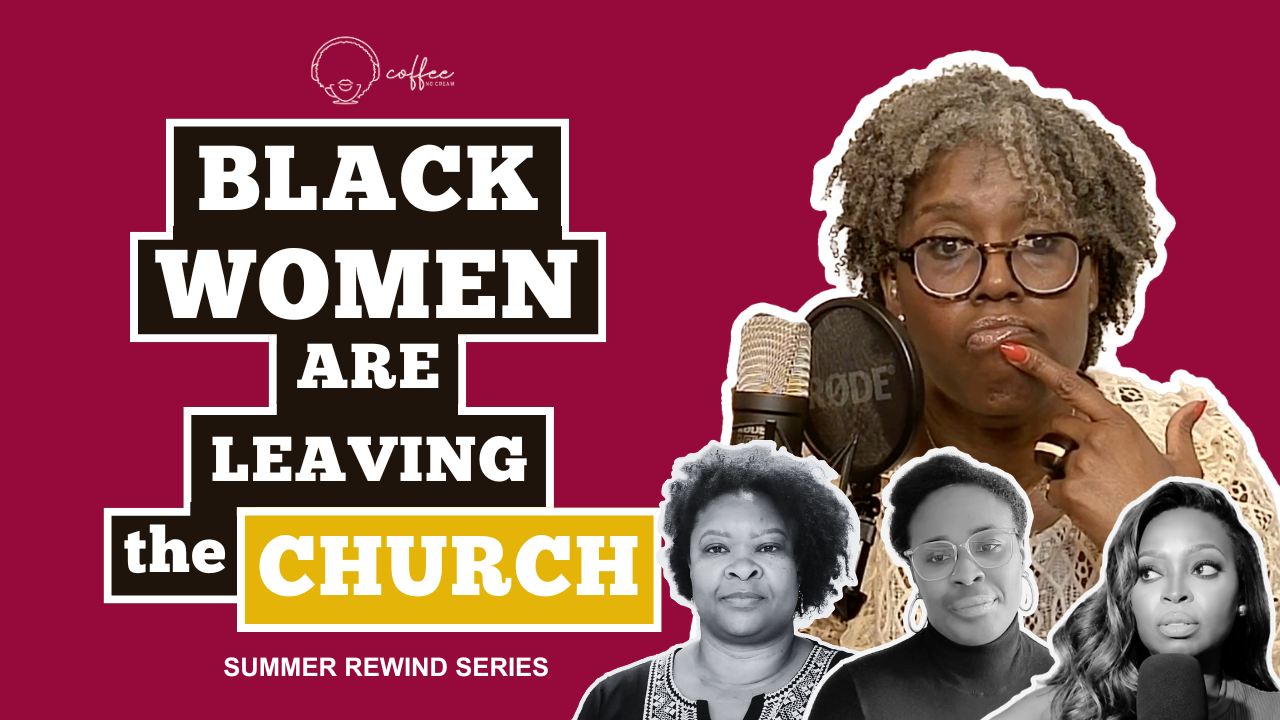
Religion, and specifically Black women deconstructing it, has been my best-performing topic on this podcast in the last year. So for this Summer Rewind, we're going back to it.
This episode pulls together my conversation with Ashante, The Unpunishable Woman, and the religion panel with Abby The Attorney and Tammy Triolo — three different religious backgrounds, three different roads to the same reckoning. Ashante walks through the judicial process her congregation put her through after she was raped. Abby breaks down the Baptist "decorum" system and what it cost her to step out of line. Tammy talks about growing up Pentecostal, and what her mother wasn't allowed to do.
This isn't an anti-faith video. It's about the systems built around faith, and what they asked of us before we were old enough to ask questions back.
There's a second panel coming, women who are deconstructing, but still believing. That one's coming soon.
Listen to the Audio
Erin Braxton (00:00)
So religion. We've talked about it on the podcast over the last year or so or more and black women and religion, the conversations, the discussion has been probably my best performing episode in the last year. In preparation for what's coming in September, we're doing summer rewind right now.
you know, we're we're we're going through some of the episodes that we've had on the podcast before. And religion is a controversial subject when it comes to black women. first I had Ashanti on the unpunishable woman and a lot of comments in the comments section confirmed what I already knew was going on, all of the deconstructing of religion that black women are doing right now, how we're revisiting and re-looking at the way that we were raised.
All of us have some form of guilt at some point or another because, you know, our minds are telling us one thing, the church is telling us another. And then I had the panel on. I had I had Ashanti back. I had Abby the Attorney, I had Damitriolo, and we had a wonderful conversation. So we're gonna revisit some of those conversations in today's summer re rewind number five.
In preparation for my next panel, which I've already put together. It's not going to be the last panel on religion. But in this particular panel and these discussions, we're talking to black women who have deconstructed, who have chosen to walk away. And our next panel, you're gonna see, are women who are still believers, but there's some deconstruction going on. So I I wanna cover all points of view.
I want to tackle it from every direction. So before we get into this rewind, though, I want to ask that you guys please like, please share, comment, leave me some comments below. You know I love that. I love to have these conversations with you guys. It's the way that we engage and get to know each other. It's the way that I hear from you and what you want to hear, what you think, you know, what I'm gonna do next. So definitely leave me.
some some some words of something. And again, we have the Facebook group, we have the almost 2,000 free educational resources. We have the things. Links are below and on the screen. And let's get into the rewind. I'll see you in a minute.
Ashanti | The Unpunishable Woman (02:43)
So I grew up as one of Jehovah's Witnesses. It's a very particular and specific...
religion, which has very, again, specific roles for men and women. And growing up in that religion and also being an adult in that religion and being single taught me a lot about systems of power, what they expect of women and the difference between what you're taught and what your lived reality often is. And my experience of leaving religion unexpectedly, because it was never a plan for
I never saw a life outside of that religion. My entire identity was consumed wholeheartedly, fullheartedly in my faith and my religion. Okay? And so when I had to leave the religion unexpectedly, it forced me to grow up and it forced me to mature. And I realized in that moment how much...
About life that I really didn't know, quite frankly, how much of myself I had self-abandoned, how much I had outsourced my identity, my self-value, my self-worth. Because when that was removed from me, I literally didn't even know who I was. It did feel like a crisis, so to speak, because everything in my life and every security, every certainty was in what I was taught about God.
but equally what I was then taught about my value in his eyes within that religion. And when I, you know, realized and learned there was a massive difference between what is taught and what happens to you as a woman in reality, I just had to grow up. That's the only way I could explain it. It forced like a system reset in order for me to survive that period of my life.
Erin Braxton (04:35)
Can you talk about what it was that made you just wake up?
Ashanti | The Unpunishable Woman (04:40)
my goodness. I mean, look, I did not, I realized I didn't know myself. So bearing in mind, I'd spent years of my life reading and studying the Bible. So one of the things I will say about that religion, especially back in the day, it's probably changed a bit now, but you know, back in the day, you would study the scriptures. And so,
You would read the Bible at least once a year end to end and it was something that I actually thoroughly enjoyed doing. I loved the research element, I loved the history element, all of the things. And so in all my, well it was my entire life up until the age of about 32, I sincerely believed that everything we are instructed to do was based upon the scriptures. That was what I was taught.
And just before I turned 30, I was raped, unfortunately, and the process within the religion is that you go to the elders. And when I went to the elders, they took me through what is called a judicial process, and I was punished, essentially. Now, the terminology they use internally is that I was disciplined, but essentially they disbelieved me and said that, look, we need to decide whether you are clean enough to remain in the congregation. And for me as a young woman having
abstained until, well, I had abstained. I'd done all of the things that you were meant to do. I was a good daughter, a good sister, a good member of the congregation. I was not on the edge of the congregation. I didn't live a double life. It was the, the best one I can describe it was a heartbreak. I felt heartbroken. I felt completely abandoned, detached from God and everything I had been taught about faith.
and identity in relation to that, it would completely destabilise, it changed me on a cellular level, the trauma, the pain, the emotional pain, the spiritual pain, it changed me on a cellular level. And I then had to make a decision, do I remain in this religion and be recorded as a sinner, even though someone harmed me, or do I leave?
And of course, leaving had consequences because my entire life was in that religion. Friends, family, et cetera. And I've never lived outside of the religion either. So if I left, it would require me to build a new life. But equally, it might mean that my family members may stop speaking to me depending upon the decision that the elders were going to take. Because one of the disciplines is that you can be what in mainstream Christianity would term excommunicated.
But the consequence of that back then would be that your family could not speak to you. And so there were some important kind of decisions I had to make about, am I going to honor my dignity or am I going to obey these invisible contracts in order to be accepted and be deemed to be worthy of God's forgiveness for a sin that I don't believe I even committed? Yeah.
Erin Braxton (07:45)
Right.
So how did your family respond to you?
Ashanti | The Unpunishable Woman (07:49)
I'm incredibly fortunate that our relationship now is the strongest it's probably ever been.
Erin Braxton (07:55)
Okay.
Ashanti | The Unpunishable Woman (07:56)
But there was no guarantee of that. I understood when I made these decisions about leaving that I'd already gone through a grieving process already. And so I had prepared myself for a life whereby my family may not have contact with me, may not talk to me, or the relationship would materially change on an emotional level.
I'm incredibly fortunate that has not happened, but I prepared myself for that mentally when I made the decision to leave.
Tammy Triolo (08:25)
Yeah.
Erin Braxton (08:26)
Where are you mentally with like, can I ask you with your faith?
Ashanti | The Unpunishable Woman (08:32)
I do still believe in a God.
And I know that's very unpopular to say these days, but I do still believe in a God, but I would not regard myself as religious. And it's so funny when I was one of Jehovah's Witnesses, there's a very clear delineation between a practicing Jehovah's Witness and someone who's not. And so that's why for me, I always say I'm not religious because I'm not actively practicing any religion. I'm not a member of a church officially or any religion, but I do still believe in a God. I think also where I'm at, and obviously this plays into my work, I do believe that
religion is a system of power, don't, and I think religion and spirituality and faith are different things. think religions that operate in an organized way have a legal entity. They are systems of power and ultimately they are there to retain their power over people. And a lot of like rank and file members of religions don't realize that because when you are,
brought into that organization, any organization, the angle is usually about your faith, right? And you and God, but you are unaware that it's an entire organization that operates like any other secular organization. It's registered with the government, there are tax benefits to them, they have a lot of money. And I think the black church, obviously here in America, you can see more of that on the outside, but actually in the religion I came from, you...
You can be an everyday publisher and completely unaware about the level of wealth that that religion actually has. And you might be struggling day to day yourself. of course, and so for me, I do believe that religions operate like systems of power, especially when they are male led and when the leadership and authority is male led and where women have no voice either in any of the ways. So for example, the judicial process I went through,
there's never any kind of, there's not a feedback box, right? So bearing in mind it's a religion where the majority of the members are women, which means that the majority of the members are women who go through this judicial process. But nobody's coming to check what the experience was like, was it done fairly, ethically, what the impact on your mental health is. There's just no check and balance on that, right? And so...
you end up as a woman being alone in a room with men being questioned about whether or not your rape is de-jaculated on you. And nobody is checking for this, nobody cares, there's no consequences, no nothing, right? That is allowed, it's permissible. And in fact, if you do try to escalate, which is quite difficult, quite frankly, if you want to complain, that's not a thing, you are navigating a system of...
power and a system of hierarchy. That's what you end up navigating, which is very different in reality to what you're sold, which is that it's all about your relationship with God. He's loving, he's there for you, he cares for you, but actually with something like that, which is very real and has a real impact on your mental health, your sanity, like I say, your dignity, there is no check and balance whatsoever. So for me, I'm not interested or inclined in joining a religion to
have to navigate another system of power in that way.
I can honestly say I do think that religion played a paternal role in my life because I grew up with my mother. And actually I can reflect back and think that the structure, the legalist aspect of the religion played a father role. And that also deepened my attachment because I enjoyed the structure. I enjoyed the rigor. And in a weird way,
Yes, you are surveilled and you're taught to surveil each other and yourself. But I think that played a very fatherly role in my life, actually, which deepened my attachment to the religion, which is why when I ended up leaving, it was so traumatic, so painful. It felt like an identity crisis because it had played this fatherly role in my life and in many ways.
Probably like a second heartbreak, right? I thought I was well over the fact that my own biological father was absent, right? But actually I think leaving the religion, it was deeper because that was the replacement father role for me in terms of its function.
Abby The Attorney (13:03)
grew up in a missionary baptist church that
People likened more to a cult than an actual Baptist church. We had a separate decorum that you were supposed to follow. It was written out and given to every member. And if you violated any part of the decorum, you had to come to conference, which was every third Wednesday. And if you had a significant violation, they would take away what was called your right hand of fellowship. And you would have to do some things to get your right hand of fellowship back.
I had difficulties in this church the entire time that I was in it. I had several times that I got into trouble when I was a teenager and had to be called in to speak to all the deacons. I was forced to apologize on several occasions. I actually paid attention to the sermons and I would point out when things were contradictory or didn't make sense, either internally or against the Bible, and they did not like that. And I
was always on my way out. I just didn't effectuate it fast enough. And then they finally kicked me out when I was around twenty, twenty-two, twenty-three. they came to my house, to my mom's house before they kicked me out to have like a conversation. I have no recollection of this conversation, but my sister says that I was belligerent through the entire thing.
And she found it hilarious. My mom was embarrassed. But I literally I remember seeing the van pull up with the church name beside it and I remember nothing after it. After that, I thought that my issue was the that particular church. And so I did try going to different churches. And I did get like very involved with the last church that I went to. I was extremely involved. I
Participated with the teens, putting together college fairs. I went to that church had different Bible studies that you could attend, like that had different titles. I would circle through the different, you know, educational options listed, but I would call myself an atheist today. I teetered along the agnostic atheist border for a long time. But I would call myself atheist today because there are things that I simply cannot reconcile. And I thought that I could just
Allow it to exist. You know, it it can exist in my life and it can be a part of my memories, it can be a part of my music, it can be a part of my culture. I don't have to reject everything until it was necessary because I have a transgender child and I cannot allow the things that are harmful to be excused because I have a couple of good memories.
Many young ladies, if they got pregnant out of wedlock, they would have to come before the church and you'd have your right-handed fellowship taken away from you, and you could only come back to the church after the sin was over, and then you could apologize for the sin and you could kind of be accepted back. You were not fully accepted back because they would still punish you in other ways. So for example.
one young lady that I was very close to, and I took this I still take this personally to be quite honest. she married the person that she got pregnant by and they forced her to get married in the gym behind the church. She wasn't even allowed to have a wedding in the church, even though she'd gone through their whole process of getting her right hand of fellowship back. When she rejoined the choir, they made her sing God of a second chance. and she couldn't.
sing any of the songs that she used to lead and so they continued punishing her. It could be something very minor too. Like my sister also was kicked out of the church and hers was because she was driving with a suspended license. In Georgia they don't tell you when they suspend your license, but anyway, and her name was in the newspaper. And so because her name was in the newspaper for being arrested, they were forcing her to come before the church to repent. She refused to do it. Her right hand of fellowship was taken away.
Tammy Triolo (17:16)
So I was raised Pentecostal. Pentecostal is a little bit more, I feel, more fervent than Baptists. In fact, we used to say that the Baptists weren't really saved, that the Pentecostals were. And so I grew up in a fire and brimstone kind of church. You had to be baptized with the Holy Ghost with evidence of speaking in tongues. And if you didn't speak in tongues, you weren't really saved or you didn't get
you hadn't had the full baptism of the Holy Spirit. And so I was raised Pentecostal in the Caribbean. and I think Pentecostals in the Caribbean is like Pentecostals here on steroids. my I grew up with a mother that didn't wear pants, didn't she was not allowed to wear pants, she didn't wear jewelry, never wore make up. I think the only thing my mother allowed herself to do was to perm her hair. And that was almost a scandal when she permed her hair. So we
grew up very mo you we dressed modestly. And at that young age, you just you you get what your parents give you. You don't have real thoughts. And I think when I was young, I I went to church because we had to go to church. I don't think I was ever really paying attention to church at a very young age. And then I moved to America and moved in with a cousin who nobody knew was gay. And
She came out to me well, she was forced out of the closet 'cause she started dating a woman and it was this woman's first experience in a lesbian relationship and so she told me my cousin was gay. And I remember my cousin being afraid that my mom would pull me from her house because my mom was so devoutly Christian. But my mom didn't do that. And all through like ra being raised Christian, even with my mother, there was some things that were like contradictory. Like my mother we were taught to homosexuality is gay, transgender would just blow their minds, really.
When we were taught that these people were gay and they were going to hell and they needed to repent and all these things, but yet the neighborhood gay person was always at our house, drinking tea with my mom, gossiping. Right? Like it's like the thing that Christi a lot of Christian women do. They like to have like pocket gays that they hang out with, they do things with, but behind, you know, when it's done it they still believe these people are going to hell, which is such a weird way of thinking.
And so I was away from church for a little bit from I was fourteen till eighteen. And I don't know what happened. At eighteen years old, like Abby said when she left, at eighteen years old I got back into the church and became fervent. Not homophobic or anything like that, 'cause I just I I was still trying to reconcile homosexuality with this faith. Right? But I w could compartmentalize that and deal with that later. But I was very fervent in church and I was a devout Christian.
For probably eight years. And I just remember one time sitting in church and thinking, I'm dying in this place. Hmm. I like I I felt like I was physically and emotionally dying in this place. And none of the messages were hitting anymore. It didn't make me hoop and holler. It didn't make me shout. I didn't feel inspired. I was like, something's off here. It was almost like my body and my spirit knew before my physical body left the building.
And I was sitting in church at the time with my husband and I said out loud, music was playing so nobody heard me, but I'm like, I'm dying in this place. And I swear on everything. I heard like somebody say, and I thought it was my husband, but I heard some somebody say, Then leave. So I looked up at my husband and I said, What did you say? And he goes, I didn't say anything. I said, You didn't say then leave? He goes, No. And I sat in the rest of that service and I never went back.
In the Pentecostal faith, there is no like you you don't get punished, you don't have to come before the church and repent, and with Jehovah's Witnesses, the surveillance and all of the punishments like that doesn't happen in the Pentecostal church. You could backslide and come back and backslide and come back, and nobody's looking at you like you did something wrong. There's no apologies needed. Everybody's just happy that you you found your way back to Christ. The way that Pentecostals
The the jail for us happens here. The way that we imprisoned ourselves was how we thought about the world around us. And when Abby was saying that her friend is having an issue with being intimate, I think a lot of Pentecostal women struggle with this too. Because you're you're told to be chase, you're told to hold yourself into marriage, you're told not to do any of these things, and then they expect you to get married and turn into a slut.
That's not going to happen. That's not going to happen. And so our punishment wasn't in the way that you had to like your right hand of fellowship would be taken away, but the way that we thought about ourselves, the way that we self surveilled ourselves, we didn't need the church to do it because the doctrine made you do it. And my fate left me, and I think a lot of us who are Pentecostal very, very judgmental. We were happy and people that we listen, we sent you to hell.
right out of the gate. Even if the pastor didn't do that, I would be looking at Abby and I'd be like, Mm, okay, well she's going to hell.
Ashanti | The Unpunishable Woman (22:39)
Thanks.
Tammy Triolo (22:40)
You know, like like one of those things. So for us it wasn't like this ph physical punishment or humiliation in the church. But the way that we're indoctrinated, we are so judgmental and we create our own cages for ourselves. So you don't need the pastor or the deacon or anybody surveilling you because you've been indoctrinated so deeply you will surveil yourself. I feel like
In the way that Christianity has made us so judgmental and hard on people, deconstructors can be the same way about Christians. And I've had to learn that for some people in this life, their walk is going to be relig with religion. And there's you you're not gonna talk them out of it. You're not gonna ration them out of it. That is their walk, that is their journey here. And for some of us, it's not. Some of us make our way out.
And when we start talking, I believe the people who listen to the deconstructors, because the faithful are not. I promise you, the faithful are not clicking on those videos, the faithful are not reading those books. The faithful are not watching the shows. They're not watching the interviews. We we don't let it in. But I feel like the people who have seeds of doubts are listening to us. I was raped by a minister, and I I think about this now. I was 17 years old. And I I think about this now, and I was like,
What was happening to me? Like like 'cause a at this point I was really getting myself back into church. And I remember being raped on Saturday night and showing up to service on Sunday where this man was preaching.
Hmm. And I think back now, like like I think about that now and I go, like what kind of conditioning has to happen to you that the man can rape you on Saturday and be in the pulpit on Sunday preaching?
Erin Braxton (24:35)
Abby.
Abby The Attorney (24:39)
Purity culture makes us perfect
Tammy Triolo (24:42)
Shame.
Abby The Attorney (24:43)
targets for sexual assault and rape. And the the issue that kept happening in my mind was the legal system offers us the least amount of protection available. And even within the legal system, spousal rape is not allowed. But yet,
I go to church and they tell me it's perfectly fine all the time. I'm in Sunday school where these women are constantly telling me that if my husband needs it, then I should submit to his desires. And if if the law outside of church offers me the least amount of protection, then why can't the church do the same? I unfortunately joined the ranks of both of you, and when I went
To church for reprieve and relief, the overwhelming consensus was this was your fault. This was your fault because of a variety of things, because you haven't been chased, because you need to concede to the demands of your partner, because you didn't pray enough, because you weren't pious enough. There were so many ways for it to be my fault.
I was able to look beyond that because no matter how much I had questioned church up until that point, it still had a hold of me. You know, ultimately it took a threat of harm to someone else for me to to feel like I'm important enough now that I can.
Tammy Triolo (26:24)
When you have that when when the men in the church think you are something you are not and and you're raised in purity culture and you're raised to respect authority and you're raised to give honor to the pastor and you're raised to give honor to the the minister, whoever it is, right? And so I was thinking I don't want to harm him.
I hadn't even considered the harm to myself. It didn't even come as a part of an equation for me. I didn't want to harm him. Because I already knew how church operates. If you say it, you're probably not gonna be believed and they're gonna believe the man of God. So why would I try to harm him and then by extension only harm myself in that?
Erin Braxton (27:08)
So those were some of the highlights on the religion topic. I am very, very much interested in continuing on, as you know. I have another panel planned. We're about to record very, very soon. I know who's going to be on it, and we're going to be talking about more of deconstructing, but not to the point where we've left like my first panel, who have just completely
walked away from the church. We are we're de we're deconstructing, but we're still believing. That's panel number two on this topic. So it's coming very soon. and I'll I'll give you some notice before it comes out. I'm super excited about that conversation. Again, thank you guys so much for joining me on the rewind today. Let me know what you think in the comments what you wanna want to talk about. What you want us to talk about on this
next panel and religion panels going forward. So we can we can make sure to address those things and hopefully help you on your journey, whatever that is. And again, thank you guys so much and I'll see you in the next one.